If you run a real estate business, you already know the job isn’t really about property. It’s about speed and relationships. Whoever calls the lead back first usually wins the deal, whoever builds trust fastest usually closes it, and whoever tracks the pipeline best usually scales it.
And yet, if you look at how most agents and brokerages spend their day, a huge chunk of it goes into work that has nothing to do with any of that: following up on the same lead five times, building a listing page from scratch for every new property, digging through call recordings trying to remember what a buyer actually said about the maintenance charges three days ago. Estimates put the time agents lose to repetitive admin and manual follow-up at well over half their working hours.
That’s the gap AI agents are starting to close — not by replacing agents, but by taking over the parts of the job that don’t need a human touch, so you can spend more of your time where it actually matters: talking to serious buyers and closing deals.
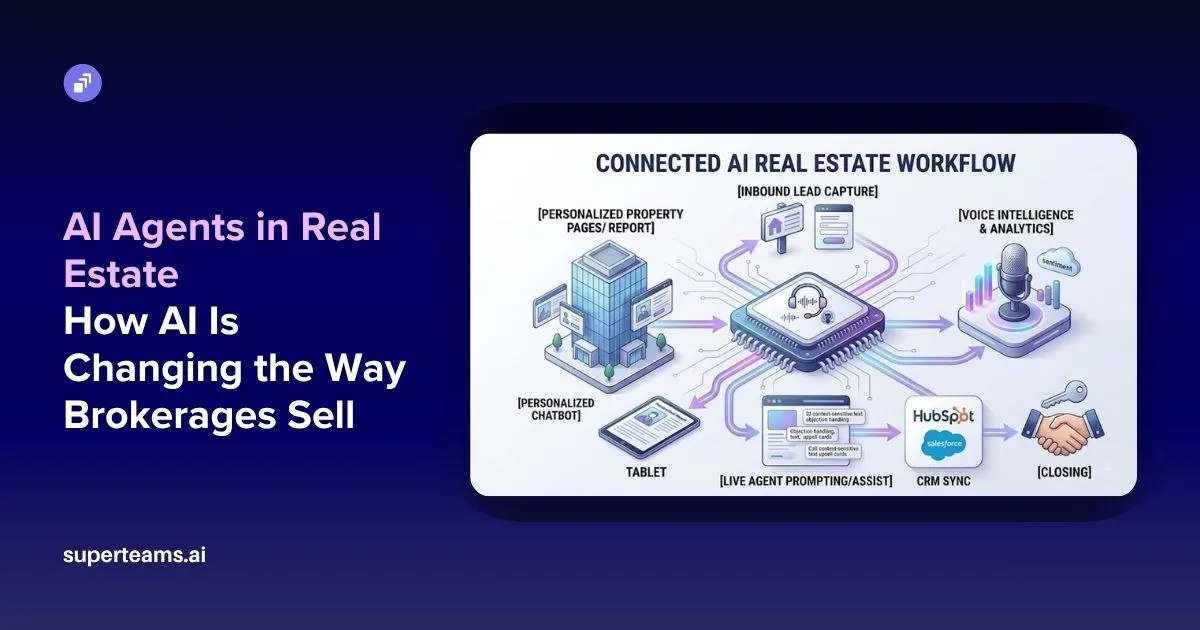
The bigger shift, though, isn’t about automating one task at a time. It’s about connecting those tasks into an AI-powered pipeline: capture the lead, qualify the buyer, create the right property experience, learn from every conversation, and give the human sales team the context they need to close.
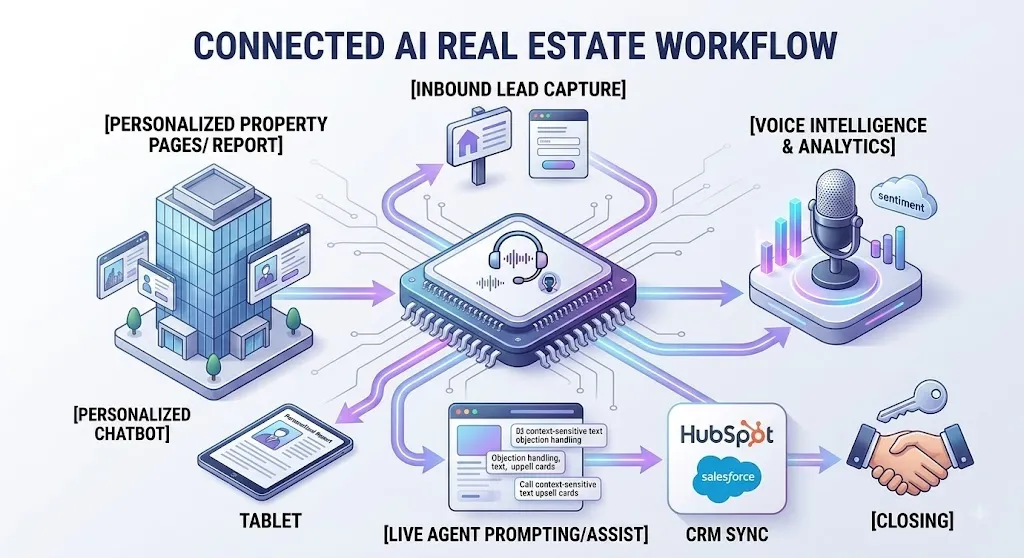
Think of it as a continuous loop. Voice AI captures and qualifies the opportunity. Builder AI turns property data into customer-facing experiences. Call intelligence turns every conversation into structured sales and market insight. That information then feeds back into the pipeline, giving your team better context for the next interaction.
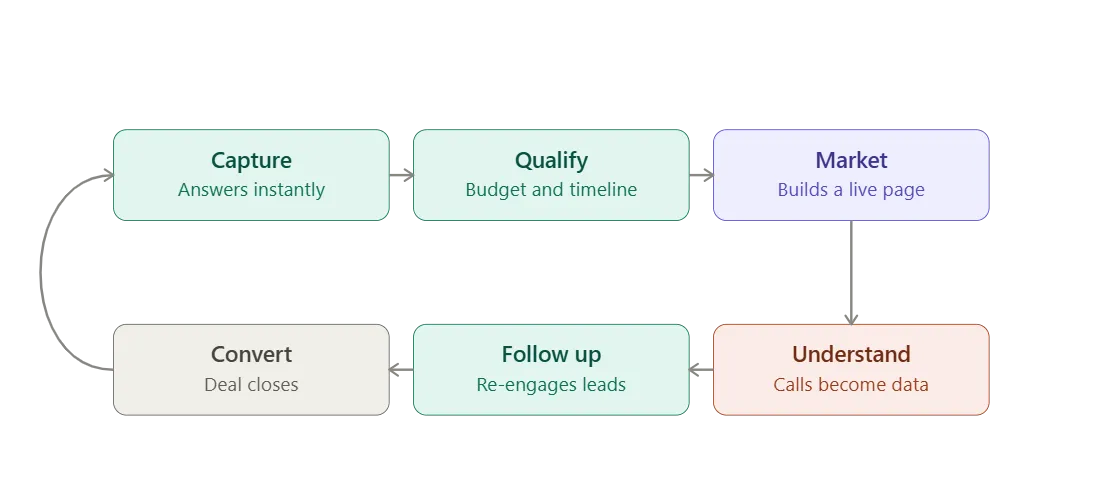
That’s where AI starts becoming more than a collection of tools; it becomes an operating layer around the sales process.
Where Traditional Real Estate Pipelines Break Down
Every real estate business runs into the same friction points, no matter the size of the team.
The first is response time. A lead that comes in through a property portal or a signboard call goes cold fast if nobody picks it up within minutes. If your team can’t answer after regular work hours, or on weekends, that lead often just moves to the next listing.
The second is marketing turnaround. Every new listing needs a page, a brochure, maybe a market report for the buyer. If that means waiting on a designer or a developer, you’re losing days you don’t have, especially in a market where the next agency might have that same listing live within the hour.
The third, and the one most brokerages don’t even realize they’re missing, is visibility into what’s actually happening on sales calls. Your CRM might have a two-line note that says “spoke to buyer, interested.” Even Salesforce, which a lot of real estate companies already run on, now bakes in AI call summaries, so that note might get a little richer on its own. But a single-call summary still isn’t the same as seeing the pattern. What were buyers actually worried about, across a hundred calls, not just one? Price? Location? Financing? Without that aggregate context, you’re coaching your team blind and guessing at what’s really stalling your pipeline.
There’s also a quieter problem sitting underneath all of this: data. One Indian real estate firm had accumulated over 15 million rows of listing data over the years, a genuinely valuable asset, except it was scattered across legacy systems with an inconsistent schema, which meant a simple question like “show me 3BHKs under 80L within 5km of a school” couldn’t be answered in real time, or sometimes at all. Superteams helped that team ingest and normalize the entire dataset, cutting query latency by 42% and getting a working AI chat prototype live within 90 days. It’s a good reminder that most of this isn’t really an AI problem first: it’s a data problem, and fixing it tends to unlock everything else.
This is exactly where a connected set of AI agents, working across calls, content, and analytics, starts to change the math.
Real Estate Voice AI: Answering and Qualifying Every Lead
Think about what happens the moment a buyer calls in about a listing. If a voice agent is handling that first response, it can pick up instantly, day or night, and answer the questions buyers usually ask first: carpet area versus super built-up area, pricing, RERA possession timelines, floor-rise premiums. In a market as linguistically diverse as India, that matters more than it sounds. A buyer in Pune might want to talk in Marathi, one in Chennai in Tamil, one in Kolkata in Bengali, and one in Delhi in Hindi or English, sometimes all switching mid-sentence. A voice agent that can hold a natural conversation across languages means you’re not stuck hiring separate regional callers just to cover your own city, let alone if you’re expanding into new markets. It also means nobody’s ever put on hold waiting for “the Tamil-speaking agent” to be free.
The same kind of agent can also work the other direction. Instead of your team manually dialing down a list of leads who went cold on a portal weeks ago, an outbound voice agent can re-engage them, confirm site visit reminders, and cut down on no-shows, all without anyone on your team lifting a phone.
What makes this genuinely useful rather than just a glorified answering machine is qualification. A well-built voice agent can ask the right questions upfront: budget range, timeline, loan eligibility and pre-approval status, and then route only the serious, high-intent buyers straight to your senior agents or directly onto their calendars. Your best people end up spending their time on people who are actually ready to buy, not on tire-kickers.
Real Estate AI Page Builder: Turning Property Data Into Live Pages, Fast
Once a listing is ready, the next bottleneck is usually marketing. You’ve got the brochure, the pricing sheet, maybe some photos, and normally, turning that into a proper landing page or a mini-site takes a designer, a developer, or at the very least, days of back and forth.
An AI-powered builder tool flips that. Feed it your property specs, PDFs, spreadsheets, or even a plain description of what you want, and it can generate a fully published, responsive page in minutes, not days. That page can double as a lead magnet, capturing visitor details automatically while it’s live.
The same approach works for client-facing reports. Instead of manually pulling together a market analysis or a valuation summary every time a buyer asks for one, you can generate polished reports on demand, using your own data as the source. And if buyers have questions while browsing a listing page, an embedded chatbot grounded in your actual property data can answer them on the spot, at 2 am on a Sunday if that’s when someone happens to be looking.
None of this needs a developer or a design team standing by. It just needs your data.
Real Estate Call Analytics: Getting Real Intelligence Out of Every Call
Here’s the part most real estate teams are sitting on without even knowing it: your sales calls are full of information you’re not using.
The obvious use case is agent coaching: how well is a given agent performing, are they sticking to the script, are they following through on what they promised, like a callback after a site visit. That’s useful, but honestly, it’s the smaller opportunity. The bigger question is what your calls, in aggregate, are telling you about the market itself.
Think about what 5,000 calls across your pipeline could actually surface if every single one of them not only transcribed but also analyzed patterns across your entire buyer base:
- Your top objections, ranked, not guessed at
- Where price sensitivity is showing up, and for which projects or configurations
- The locations buyers keep asking for, even if you don’t currently have inventory there
- Which configurations (2BHK versus 3BHK, specific floor plans) are actually generating demand right now
- Recurring financing and loan eligibility concerns that might mean your payment schedules need rethinking
- Competitor mentions, so you know exactly who buyers are comparing you against and why
- Objections specific to a single project, like a particular builder’s reputation, RERA possession delays, or floor-rise premiums that keep coming up for one listing but not others
- Genuine site-visit intent versus buyers who are just browsing, so your team knows where to focus
- The actual reasons leads go cold, instead of a CRM field marked “not interested” with no context
- How your agents actually compare to each other, not on one call, but across hundreds, so you can see who’s consistently turning hesitant buyers around and who’s losing them at the same point every time
That’s not one-call feedback anymore, that’s market intelligence. It tells you where to build next, how to price a launch, which locations to prioritize, and which objections your marketing and sales scripts need to get ahead of, before you’ve spent a rupee on the wrong listing or the wrong city.
If ten buyers this month independently brought up the same objection, whether it’s RERA possession delays or connectivity to the workplace, that’s not a coincidence. That’s something you can actually act on, whether it means adjusting how a listing is priced, how possession timelines are communicated, or which project you greenlight next.
Live Prompting AI: Backing Up Your Human Agents Too
Everything above is about understanding calls after they happen. There’s a live version of the same idea too, one that helps even when a human is the one talking, in real time, mid-conversation.
When your agent is live on a call, the same underlying system can listen in and surface prompts in real time, pulled straight from your company’s own listing data and sales playbook, based on whatever the buyer is actually asking. A buyer mentions they need a home office and the tool nudges the agent toward the 3BHK with the study nook two floors up that they’d have otherwise forgotten to mention. A buyer says the current unit is a bit over budget and it surfaces a comparable configuration in a nearby project with better payment terms.
None of this requires the agent to have memorized your entire inventory. It just means the upsell or cross-sell that used to depend on one person’s memory on a good day now shows up on screen within seconds, with low enough latency that it doesn’t break the flow of a live conversation. Your most experienced agent and your newest hire end up drawing on the same institutional knowledge in real time, instead of one of them winging it.
How It All Works Together
None of these pieces are meant to work in isolation. The real value shows up when they’re connected.
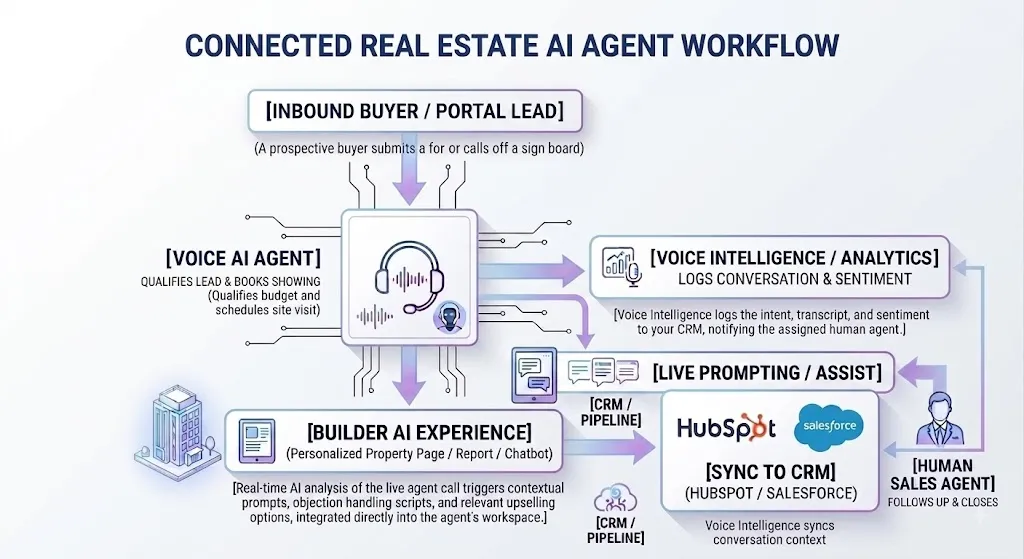
- A prospective buyer submits a form or calls in off a signboard.
- The voice agent contacts the lead within seconds, qualifies their budget, and schedules a site visit.
- The builder tool dynamically generates a personalized property page or market report tailored to that buyer’s preferences.
- Call intelligence logs the intent, transcript, and sentiment straight into the CRM, notifying the assigned human agent.
- When that human agent follows up, live prompting surfaces the buyer’s stated preferences and any relevant configurations or nearby projects in real time, so the agent walks in already briefed and ready to upsell or cross-sell without digging back through the transcript first.
The buyer never notices any of the machinery. All they experience is a fast, informed response. Your team, on the other hand, walks into every follow-up already briefed.
This connected approach is already playing out in the market. A real estate platform in West Asia wanted to collapse the usual fragmented journey (search on one app, screenshot listings, message an agent, wait for a callback) into a single conversation. Superteams built a conversational broker that takes both text and voice input, queries live property listings in natural language, generates side-by-side comparisons, and lets buyers shortlist and book, all inside the same chat session. Conversion improved simply because buyers never had to leave the experience, and agent workload dropped since the AI was handling discovery and comparison on its own, freeing agents up for the negotiations that actually need a human.
What to Actually Measure
If you’re evaluating whether this kind of setup is worth it for your business, a few numbers matter more than the rest.
Speed-to-lead is the big one. Going from hours (or worse, a missed call altogether) down to under a minute of first contact tends to have an outsized effect on conversion, simply because so few competitors respond that fast.
Conversion rate matters just as much, specifically how many portal leads actually turn into booked site visits. And cost per acquisition tends to drop noticeably once you’re not paying for a large calling team just to keep up with call volume, while your actual coverage goes up to round-the-clock.
One more thing worth watching: listing turnaround time. If you can go from acquiring a new listing to having it live and marketed in hours instead of days, that’s a real edge in a market where speed to publish often matters almost as much as the property itself.
The Bigger Picture
None of this is about replacing agents or brokers. Real estate is still, fundamentally, a relationships business, and buyers still want to talk to a person before they sign anything as big as a home purchase.
What’s changing is where your team’s time goes. Instead of spending hours on the low-leverage parts of the job (answering the same questions, chasing cold leads, building pages, listening back through call recordings) AI agents can take that work off your plate and hand your team the insight and the qualified leads to act on.
If you’re running a brokerage or real-estate business and want to explore what this kind of AI-enabled pipeline could look like for your listings, sales team and CRM, Superteams.ai can help you identify the workflows worth automating and build the right AI stack around them. Book a demo or talk to an engineer to see what it would take to get started.