Executive summary
- India’s NBFC sector now carries retail credit AUM of roughly ₹137 trillion (~USD 1.46 trillion) as of March 2026, growing 19% year-over-year, and NBFC credit has climbed to about 16.7% of India’s nominal GDP (RBI Deputy Governor remarks, 2026). That scale is running through loan origination systems (LOS) that most lenders built for a paper-and-branch era, not for the speed borrowers now expect.
- India’s Account Aggregator ecosystem facilitated ₹3.82 lakh crore in loans across 3.68 crore accounts in FY26, and now accounts for 8.4% of retail and MSME lending by value (Sahamati ecosystem data, reported August 2026). The infrastructure for instant, consent-based underwriting data already exists — most LOS platforms simply aren’t built to use it end to end.
- The bottleneck isn’t any single step. It’s that sourcing, underwriting, and collections still run as three disconnected systems stitched together by manual handoffs, phone calls, and PDF uploads, each one adding a day or more to a process that modern AI tooling can compress into hours.
- This post lays out what a genuinely modern, AI-powered LOS looks like end to end — sourcing and lead conversion, AI-assisted underwriting, disbursement, and collections — and maps the specific AI capabilities (document AI, computer vision, conversational AI, generative drafting) onto each stage.
- The target worth building toward is sanctioning a loan in a few hours and disbursing it the next day. A handful of NBFCs are already close; if yours is still measured in days, that gap is now a competitive problem, not just an operational one.
How Big Is India’s NBFC and Digital Lending Market?
India’s digital lending platform market is projected to reach USD 2,454.4 million by 2030, growing at roughly 31.5% CAGR from 2025 (ResearchAndMarkets, reported via Businesswire). That growth is landing on an NBFC sector that’s already large and expanding fast: NBFC assets under management stand at roughly ₹48–50 trillion, growing 18–19% annually, and system-wide retail credit AUM (banks plus NBFCs) reached ₹137 trillion as of March 2026, up 19% year-over-year (Wright Research, 2026; Kilde, 2026).
The underwriting data layer underneath that growth has also changed materially. Sahamati’s FY26 ecosystem data shows the Account Aggregator framework facilitating ₹3.82 lakh crore in loans across 3.68 crore loan accounts, now covering 8.4% of India’s retail and MSME lending by value and 11.8% by volume. AA-enabled home loans and loans against property alone grew 624% year-over-year to ₹20,777 crore across 1.09 lakh loans in FY26 (Sahamati ecosystem data, reported August 2026) — direct evidence that secured lending, not just small-ticket personal loans, is moving onto consent-based digital underwriting.
None of that scale or infrastructure guarantees you a fast loan, though. It only means the raw material for a fast LOS — clean, consented financial data, delivered in seconds instead of a bank-statement PDF — now exists at national scale. What you do with that data, and how much of the rest of your origination process still runs on manual steps, determines whether “digital lending” actually means fast lending for your borrowers.
Why Most Loan Origination Systems Still Bottleneck at Sourcing and Underwriting
Lead conversion is the first place the promise of digital lending breaks down. Most Indian NBFCs still source a large share of their loan book through direct selling agents (DSAs) using apps and workflows built for data collection, not fast conversion — and industry-wide, converting a lead into a sanctioned loan routinely takes several days, even when the borrower’s KYC and mobile number are already on file. A handful of digital-first NBFCs are now pushing that down toward a two-day conversion window, which is itself considered aggressive by current market standards.
Account Aggregator adoption, despite its scale, still has real friction at exactly this stage. NBFCs that launched AA-only lending flows in 2024–2025 saw a 62% application failure rate at the data-collection step, because the borrower’s bank wasn’t yet AA-enabled, and a 56% customer drop-off rate once told their bank wasn’t supported — against an 18% baseline drop-off when a fallback option exists. Adoption also varies sharply by geography: metro cities show 45–50% AA adoption, while Tier 2 and Tier 3 cities — where a large share of NBFC lending actually happens — sit at just 20–30% (Precisa, 2026). If you build your LOS around AA data alone, with no fallback path, you’re choosing to fail more than half your Tier 2/3 applications at the first data-collection step.
Underwriting has a different bottleneck: it still depends on people doing things a system could do faster. A field visit to assess a property, a phone call to verify occupancy or income, a manual review of photographs to spot red flags — every one of these steps exists for a good reason, but every one of them today runs on a human’s calendar rather than a system’s throughput. RBI’s own regulatory attention reflects how central this stage has become: the RBI’s Digital Lending Directions, 2025 and its FREE-AI Committee Report (released August 13, 2025) both treat underwriting-stage governance — model validation, documented approval workflows, continuous monitoring — as a first-class compliance requirement, not an afterthought (KPMG summary of the FREE-AI Committee Report, 2025). Any AI layered into underwriting has to satisfy that governance bar, not just move faster than a human reviewer.
Collections closes the loop, and it’s where a slow, disconnected LOS compounds its own earlier mistakes. A borrower underwritten too loosely because a valuation or income check got rushed becomes a collections problem months later — one that most NBFCs still handle through manual telecalling, hand-drafted notices, and recovery workflows with little connection back to the underwriting data that predicted the risk in the first place.
What “AI-Powered” Actually Means in a Modern LOS
“AI-powered lending” gets used loosely enough that it’s worth being specific about which AI capabilities actually do useful work inside an LOS, and where each one sits in the process — so you know exactly what you’re evaluating the next time a vendor pitches you one:
- Conversational AI and speech-to-text turn every underwriting and collections phone call into a searchable, structured record — recording and transcribing customer conversations, then extracting the specific facts an underwriter or collections agent needs (stated income, occupancy status, promised payment date) instead of leaving them buried in an audio file nobody replays.
- Computer vision on property and asset photographs extracts structured data directly from the images a field agent already captures — condition, approximate size, visible defects — and can produce a geotagged location record that confirms the visit actually happened at the claimed property.
- AI-assisted valuation combines that photo-based extraction with comparable-property and market data to produce a fast preliminary valuation estimate, which a certified valuer still reviews and signs off on for anything above a defined risk threshold — the AI accelerates the first pass, not the regulatory sign-off.
- Document AI and OCR pull structured fields out of KYC documents, bank statements, and property paperwork, replacing manual data entry at exactly the points where sourcing and underwriting historically lost the most time to re-keying.
- Generative AI for drafting produces the underwriting memorandum, the sanction letter, and — on the collections side — the recovery notices, from structured case data, so a human reviews and approves a draft instead of writing one from a blank page every time.
- Orchestration across sourcing, underwriting, and collections data is what turns these individual capabilities into one system rather than five disconnected tools — the same customer and case record needs to flow from the DSA app through underwriting to disbursement to collections without anyone re-entering it.
None of these capabilities is exotic by 2026 standards. What’s rare is an LOS that wires them together end to end, with the credit bureau and Account Aggregator pulls, the property assessment, the call transcription, and the collections workflow all reading from and writing to the same case record.
Why This Matters Now for Indian NBFCs
If you’re leading technology, risk, or operations at an Indian NBFC, three pressures are converging on you at the same time, and none of them are going away.
The competitive pressure is the most visible one. Borrowers increasingly expect the speed they get from consumer apps in every other part of their financial life, and the NBFCs already pushing lead conversion toward two days and disbursal toward a single day are setting the market’s new baseline — not a theoretical best case. If your sourcing-to-disbursal cycle is still measured in a week or more, you’re not just slower; you’re visibly losing borrowers to a lender the market now considers merely “fast,” not “exceptional.”
The regulatory pressure runs in the same direction, but with teeth. FREE-AI’s governance pillar already expects RBI-regulated lenders to demonstrate that they’ve formally validated any model touching a credit decision, approved it through a documented workflow, and monitored it continuously for drift and bias. That’s not a constraint on moving fast — it’s a design requirement for how you move fast, which means the underwriting AI has to be built with an audit trail and a human-review checkpoint from day one, not bolted on after a regulator asks for one.
The data-infrastructure pressure is the newest of the three, and it cuts the other way: for the first time, the Account Aggregator ecosystem gives you access to consented, verified financial data in seconds rather than days, at a scale — ₹3.82 lakh crore in FY26 loans — that makes it a mainstream channel, not an experiment. If your LOS hasn’t been rebuilt to actually use that data end to end, with a sensible fallback for the borrowers AA doesn’t yet reach, you’re leaving a genuine speed advantage on the table while competitors pick it up.
Put together, these three pressures point at the same conclusion: the LOS itself, not any single AI model, is now the thing standing between an NBFC and a loan it can sanction in hours and disburse the next day.
How to Architect a Modern AI-Powered Loan Origination System
Here’s how the four stages fit together — and the components inside each one matter less than whether you’ve wired them to share one underlying case record instead of five disconnected systems.
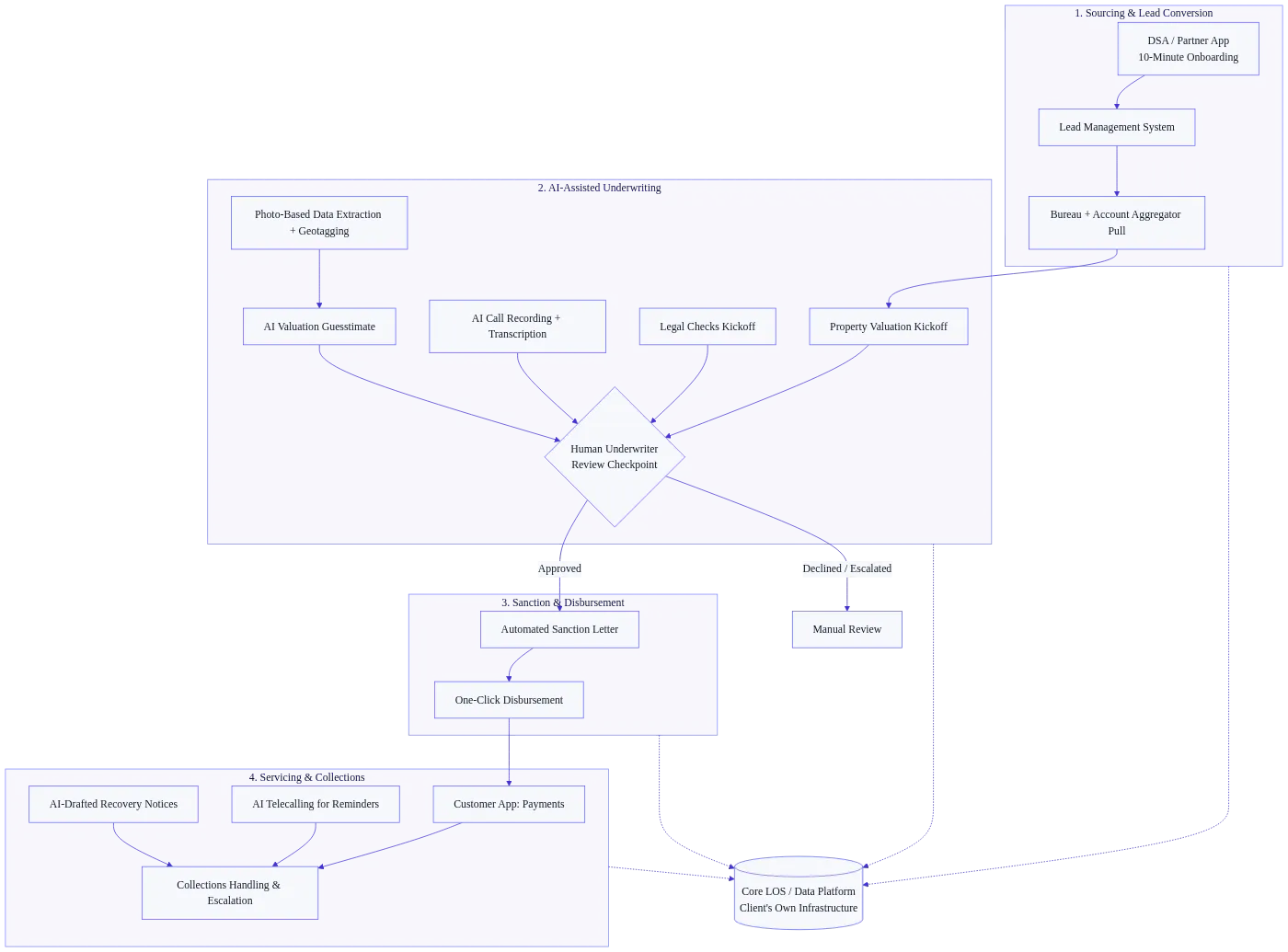
Walking through each stage:
- Sourcing and lead conversion starts at the DSA or partner app, designed for a fast onboarding journey rather than a data-collection form — pre-filling KYC and contact details the lender may already hold, then handing the lead straight into a lead management system that pulls bureau data and Account Aggregator data in the same flow, with a manual-upload fallback for the borrowers AA doesn’t yet reach.
- AI-assisted underwriting kicks off property valuation and legal checks in parallel rather than in sequence, while conversational AI records and transcribes every customer call, computer vision extracts structured data and a geotag from property photographs, and an AI valuation model produces a preliminary estimate. Every one of those outputs feeds a human underwriter’s review screen — the AI does the first pass, the human makes the call, and every decision path has a documented, auditable trail.
- Sanction and disbursement turns an approved case into a generated sanction letter and a one-click disbursement, with no re-keying of data the system already has from the sourcing and underwriting stages.
- Servicing and collections gives the borrower a single app for payments and account status, while AI telecalling handles routine repayment reminders, generative AI drafts recovery notices from the case’s actual payment history, and human collections agents step in for genuine escalations rather than routine follow-ups.
All four stages read from and write to one core LOS data platform, running on the lender’s own infrastructure — which is what lets an underwriting AI model retrain on the lender’s own portfolio, and what lets a compliance officer pull a complete, single-source audit trail for any case an examiner asks about.
Where AI Fits Into the Architecture — and Where It Doesn’t
Mapping AI onto that architecture only holds up if you’re honest about which boxes AI actually occupies and which ones still require a human, because that distinction is exactly what your regulator and your risk committee will ask about.
AI does real work at several points: extracting structured data from documents and photographs, transcribing and summarizing calls, producing a preliminary valuation estimate, drafting the underwriting memorandum and the sanction letter, running the collections telecalling and notice-drafting workload, and orchestrating the case record across all four stages so nobody re-enters the same data twice.
AI does not replace the underwriter’s sign-off, the certified valuer’s final valuation report where regulation requires one, or a lawyer’s legal-title clearance — those remain human decisions with AI supplying a faster, more complete first pass rather than a final answer. It also doesn’t replace the human collections agent for a genuinely disputed or escalated case; it replaces the repetitive reminder calls and boilerplate notices that currently consume most of a collections team’s time, freeing that team for the cases that actually need judgment.
That division is also what makes the system auditable. A regulator asking “which model produced this decision, validated against what data, and who signed off on it” gets a straightforward answer at every stage, because the architecture never lets a model’s output become a final decision without a logged human checkpoint sitting right behind it.
How to Roll Out an AI-Powered Loan Origination System in Phases
Here’s what that rollout looks like when you actually build it, phase by phase. Picture a mid-sized Indian NBFC — a composite, illustrative example, though it may look a lot like your own operation — running several thousand secured personal and property-backed loans a month through a legacy LOS, an in-house IT team maintaining it, and a sourcing funnel that still takes the better part of a week to move a lead from first contact to sanction.
The first phase of modernizing this system is sourcing: replacing the DSA app’s data-collection form with a fast onboarding flow, wiring in the bureau and Account Aggregator pulls with a manual fallback, and cutting lead-to-decision time from days to hours purely by removing re-entry and wait time between steps that were already digital but never connected. The second phase adds the AI underwriting layer — call transcription, photo-based property data extraction and geotagging, a preliminary valuation estimate — feeding a human underwriter’s review screen instead of a paper file, which is what actually gets a well-documented case sanctioned within hours instead of days. The third phase automates disbursement and rebuilds collections around the same case record, so a sanctioned loan can be disbursed the very next day, and a payment reminder, a notice, or an escalation all draw on the same underwriting history instead of a fresh manual lookup.
None of these three phases requires waiting for the others to finish — you can ship the sourcing phase, measure the lead-conversion improvement, and use that evidence to justify investment in the underwriting phase next. That sequencing is also what gets your existing IT team comfortable augmenting rather than replacing your current LOS, since each phase plugs into the same case-record backbone rather than requiring a rip-and-replace migration. Get all three phases running together, and sanctioning a loan in a few hours and disbursing it the next day stops being an aspirational target and becomes what your system actually produces on a normal case.
Why We Build This — and What to Do Next
This is exactly the kind of system we build as an embedded, R&D-first team: not a point-solution vendor selling one piece of the LOS, and not a staffing shop supplying bodies to a client’s existing roadmap, but a team that designs, builds, and deploys the full sourcing-to-collections architecture on the client’s own infrastructure. We wire in the AI capabilities — document extraction, computer vision on property photographs, conversational AI for calls, generative drafting for memoranda and notices — as part of one delivery, validated against the lender’s own portfolio data before any of it touches a live underwriting decision.
We typically deliver a working, production-grade version of this system in 2–3 months, against the 12–18+ months a from-scratch in-house build usually takes, with the client owning the resulting IP outright and no vendor lock-in. Our core team is based in India, backed by a global network of fractional AI researchers we bring in for the genuinely hard problems — model validation and drift monitoring for the underwriting layer among them — and we work alongside a lender’s existing IT and underwriting teams rather than displacing them, since augmenting a CoE that already knows the business is usually faster than replacing it.
For NBFCs evaluating how to move from a multi-day sourcing-to-disbursal cycle toward sanctioning a loan in hours and disbursing it the next day, the fastest path usually isn’t a single point solution bolted onto the existing LOS — it’s rebuilding the underlying case-record architecture so sourcing, underwriting, and collections finally share one system instead of three. If that’s the target your team is working toward, get in touch to see what a first working phase of that system could look like on your own infrastructure.