Ask a chatbot to draft a reply to an unhappy customer, and it can do a decent job in seconds. Ask it to look up the customer’s order, check the refund policy, initiate the refund, update the CRM and send the reply, and the task becomes more complex. A chatbot without the necessary integrations and permissions can explain what needs to happen, but it cannot complete the workflow on its own.
That is the gap AI agents are designed to address.
Much of the recent business AI conversation has focused on generating things: text, summaries, code and answers. But agents themselves are not new. Software that senses its environment, makes decisions and takes action has existed for decades, from rule-based systems to robotic process automation (RPA). What has changed is that language models can now help agents interpret goals, determine the steps involved, use software tools and company data, and adapt their next actions based on the results. With the right integrations, validation and safeguards, a system can move beyond recommending what to do and begin carrying out parts of the task.
The shift is from asking AI, “What should I do?” to giving it a goal and defining what it is allowed to do to achieve it.
Interest in agents is running well ahead of readiness. In a January 2025 poll of 3,412 webinar attendees, Gartner found that only 19% of organizations had made significant investments in agentic AI, while 42% had taken a more conservative approach. The same firm expects that by 2028 at least 15% of day-to-day work decisions will be made autonomously by agentic AI, up from 0% in 2024. The useful question is no longer whether agents are worth taking seriously. It is what it actually means when AI starts to decide, and how you let it do that sensibly.
From Generating Answers to Completing Workflows
The simplest way to see the shift is to look at what sits around the model. A conversational AI is a model and a text box. An agent is a model with hands: access to your ERP, your CRM, your ticketing system, your document store, plus the ability to plan a sequence of actions and decide what to do next based on what comes back.
That changes the unit of work. A chatbot answers a question. An agent owns a task, like reconciling a vendor invoice against a purchase order, or chasing a missing KYC document across email and your internal systems. The output is not a paragraph you copy and paste somewhere. It is a finished step in a workflow, with a trail of what was checked and what was done.
This is also why enterprise data matters so much more than it did a year ago. A clever model with no access to your policies, customer history or inventory can only guess. The same model connected to the right sources can act on facts.
Why Enterprise Workflows Need More Than Traditional Automation
None of this means rule-based automation is obsolete. Fixed rules are excellent when the process is stable, the inputs are clean and the outcomes are predictable. Payroll runs, GST filing reminders and standard approval routing are all good examples. If the same thing happens the same way every time, a script or an RPA bot is cheaper, faster and easier to audit than any agent.
The trouble starts when real life leaks in. Inputs arrive in the wrong format. A document is missing. Two systems disagree. A customer asks for something the rulebook never imagined. Rules handle this in one of two ways: they fail, or they push the case to a person. Teams then spend a surprising share of their day on the exceptions, not the routine.
Take accounts payable at a mid-sized Indian manufacturer. A rules-based setup can match an invoice to a purchase order when the numbers line up perfectly. But what happens when the vendor’s invoice carries a slightly different GSTIN format, the quantity delivered is 98 against an order of 100, and the goods receipt note was uploaded to a different folder? A rule sees a mismatch and stops. An agent can look at the situation: pull the delivery record, check the tolerance your finance team has set for short deliveries, find the GRN, and either clear the invoice or route it to the right person with the exact reason it was flagged. The routine invoices still flow through the rules. The messy ones get reasoning instead of a queue.
That is the useful way to think about it. Rules for the predictable core, agents for the judgment-heavy edges, and a clear line between the two.
How an AI Agent Makes and Executes Decisions
Under the hood, an agent runs a loop, and each part of that loop is worth understanding because each one can go wrong.
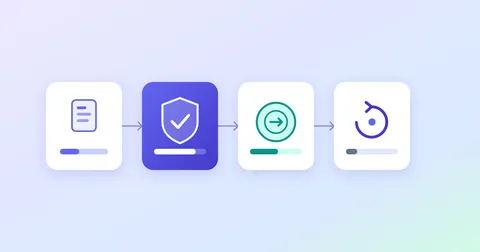
It starts with planning. Given a goal, the agent breaks it into steps and decides what to do first. Then comes tool use: the agent calls an API, queries a database, reads a file or sends a message to carry out a step. Along the way it relies on context retrieval, pulling in the policies, past cases and live records that are relevant to this particular decision rather than relying on what the model happens to remember. Before anything consequential happens, a good design adds validation, where the agent’s proposed action is checked against rules, limits or a second reviewer. Finally there is feedback: the result of each action goes back into the loop, so the agent can adjust, retry or stop and ask for help.
Here is the part that deserves a plain statement. An agent that reasons well can still be wrong. Reasoning produces a plausible chain of steps, not a guaranteed correct one. It can retrieve the wrong document, misread an exception or act confidently on stale data. That is why the validation and feedback pieces are not optional extras. They are what separates an agent you can trust with real work from a demo that looks impressive.
Three Changes Agentic AI Could Bring to Enterprise Operations
If agents work the way their best advocates hope, three things start to shift inside a company.
Goal-oriented task delegation
Today you delegate steps: run this report, send this reminder, update this field. With agents, you can delegate outcomes. “Get all pending vendor invoices for September reconciled by Thursday” becomes an instruction the system can break down and work through, rather than a project plan someone has to manage. The manager’s job moves from assigning steps to defining the goal and the limits around it.
Context-aware exception handling
Earlier we saw that exceptions are where rules break down. An agent can read the surrounding context, such as the customer’s history, the contract terms and the last three emails, before deciding how to handle an odd case. It will not get every call right. But a first pass that resolves the simple exceptions and hands the hard ones over with a clear summary already saves a lot of back and forth.
A shift toward human supervision and strategic decision-making
This one is easy to misread as “fewer people.” A more realistic picture is different work. People spend less time chasing, copying and checking, and more time reviewing what agents did, handling the cases that need judgment and deciding where the business should go next. EY’s survey for 2026 found that 64% of respondents expect only selective displacement, mainly in outsourced and standardized functions, and some firms are already creating new roles such as agentic engineers. Supervision becomes a real job with real skills attached.
What It Takes to Deploy Agents in an Existing Enterprise
Most of the hard work in an agent project has little to do with the model. It lives in the plumbing and the policies around it.
Start with integrations and data access. An agent is only as useful as the systems it can reach, and most Indian enterprises run a mix of modern SaaS, older ERP modules and a lot of spreadsheets and email. Connecting these cleanly, and making sure the data the agent reads is current and trustworthy, usually takes longer than anyone budgets for.
Then comes permissions. Treat an agent like a new employee on day one: give it access to what the task needs and nothing more. Read access is different from write access, and write access to a payments system is different again. Every action should be logged, so that when someone asks “why did the agent do that?” there is a real answer.
Testing needs a different mindset too. You are not only checking that the software runs. You are checking how it behaves on messy, ambiguous, adversarial inputs, using real historical cases where you already know the right outcome. Once it is live, monitoring matters just as much: tracking accuracy, escalation rates, cost per task and the cases where a human overrode the agent.
Human approval should be built in at the points where mistakes are expensive, such as payments above a threshold, changes to customer records or anything that touches compliance. Then roll out gradually. Begin with the agent suggesting and a person approving, move to the agent acting with sampling checks, and extend autonomy only as the evidence builds.
This governance layer is where many Indian firms are thin today. ServiceNow’s index, conducted in September 2026, found that only 22% of surveyed organizations had AI testing, auditing and risk-assessment processes in place, even as investment in enterprise AI in India grew 119% over the past year. Spending is racing ahead of safeguards, and that is a risky place to be.
How Businesses Should Decide Where to Start
The temptation is to pick the most exciting use case. Resist it. A good first workflow is boring in the best way, and four questions help you find it.
- Is the volume high enough to matter? A process that runs hundreds of times a week gives you data, learning and a visible payoff. One that runs twice a month does not.
- Is the pain in the exceptions? If the routine path is already smooth, an agent adds little. Look for work where people lose time on mismatches, missing information and follow-ups.
- Is the data reachable and the risk contained? Pick something where the systems have usable APIs and where a wrong decision can be caught and reversed. Internal back-office work such as invoice matching, vendor onboarding queries or support ticket triage usually beats anything customer-facing or payment-releasing for a first project.
- Do you know what “right” looks like? You need historical cases with known good outcomes, so you can test before you trust.
Once you have a candidate, decide how you will judge it before you build anything. Record a baseline for the current process: how long a case takes, what it costs, how often it goes wrong and how often it needs rework. After launch, compare on those same numbers, and add two agent-specific ones: how often the agent had to escalate, and how often a human reversed its decision. If cycle time drops but reversals climb, you have not improved the workflow. You have moved the work somewhere harder to see.
Gartner’s advice for this early stage is blunt: pursue agentic AI only where it offers clear value or ROI, and in many cases rethink the workflow itself rather than bolting an agent onto an old process. A small win you can measure builds more confidence, and more budget, than a sprawling pilot nobody can evaluate.
Conclusion: Match Autonomy to the Task, the Evidence and the Risk
AI that can decide is not a single switch you flip. It is a dial. At one end, the system drafts and a person decides. At the other, the system acts on its own and a person reviews samples. Neither end is right for everything.
The principle that holds up across every example above is simple. Give an agent as much autonomy as the task allows, the evidence supports and the risk can tolerate. A low-risk task with plenty of tested history can run with light supervision. A high-value decision with thin data and real consequences should keep a person in the loop for much longer. And the dial can move as the track record grows.
The companies that get the most from agents will probably not be the ones that automate the most. They will be the ones that choose their first workflows carefully, measure honestly and widen autonomy only when the numbers earn it.
If you are mapping out where agents could fit in your own operations, that is the kind of work we do at Superteams.ai: working through which workflows are worth automating, building agents around your existing systems and setting up the guardrails to run them safely. A short conversation about one real workflow is usually the best place to begin.