The Next Generation of Contact Centres is AI-powered
Think about a single day in your contact centre. Thousands of calls come in about payments, policies, plans and complaints, and every one of them carries business information: why customers are unhappy, what they have promised to pay, which product they are about to drop.
Yet when a call ends, much of that information is reduced to a few lines of manual CRM notes. The recording remains available, but the insights inside it rarely make their way into everyday business decisions.
That is the quiet cost of the traditional contact centre. It produces a huge volume of conversations every day, yet most of the intelligence inside them is lost to manual notes, fragmented call records and reports that arrive days late. The IVR, the dialler, the agent desktop and the CRM each do their own job, but they rarely work as one system.
AI changes that. Voice agents can now handle routine enquiries, assist human agents in real time, and turn every conversation into structured data your teams can act on. Customers are ready for it. The Zendesk 2025 CX Trends findings for India show that 69% of Indian consumers have already used voice AI, and Salesforce’s State of Service research expects AI to resolve around half of service cases by 2027, up from about 30% in 2025.
Here is the part that often gets missed. Adopting these capabilities does not mean ripping out your CRM, your dialler, or your telephony stack. The real opportunity is not bolting a chatbot onto a contact centre. It is building an AI-powered system that connects customer conversations with the business processes sitting behind them. This blog walks through what that looks like, and how Superteams.ai helps companies build it.
What an AI-powered contact centre should look like
There is a big difference between a call centre with a few AI features sprinkled on top and one that is genuinely built around AI. The first adds a transcription tool or a chatbot. The second treats AI as an active participant in every customer interaction. In practice, that comes down to five capabilities working together.
The first is AI-powered voice interactions. Voice agents pick up routine enquiries, collect the information a human would otherwise have to ask for, answer common questions and run outbound calling workflows such as payment reminders or appointment confirmations. Your human agents are freed up for the conversations that actually need them.
The second is intelligent call routing and human handoff. A good system knows its limits. When a conversation turns complex, sensitive or simply outside what the AI is permitted to handle, it transfers the call to the right team and passes along the context, so the customer never has to start over.
Third comes real-time agent assistance. While a human agent is on a live call, AI can surface relevant customer information, suggest next steps and pull up the right policy or product detail, which shortens the call and reduces errors.
Fourth is automated post-call intelligence. Every call is transcribed, summarised and classified, then analysed for outcomes, commitments, customer sentiment and compliance indicators. The work that used to depend on an agent’s memory and typing speed happens automatically.
The fifth capability ties the rest together: unified conversation records. Transcripts, recordings, summaries and action items are linked to the same customer interaction, instead of living in three different tools.
These capabilities draw high-level inspiration from AI-native call centre architectures that combine real-time voice AI, human-agent handoffs, telephony infrastructure, APIs and unified call records. The point is not any single feature. It is how the pieces connect.
Why integrating AI with your existing CRM matters
Most companies already have a CRM, a dialler and a set of support workflows that their teams know well. Replacing all of it to get the benefits of AI is expensive, slow and risky, and it usually isn’t necessary. The better question is how AI can plug into what you already run.
Three problems show up again and again when it doesn’t. The first is fragmented customer context. Agents jump between the CRM, the dialler, call recordings and a handful of other applications just to understand who is on the line. The second is disconnected call outcomes. Summaries, follow-up commitments and customer responses have to be typed into the CRM by hand, which means they are often late, incomplete or missing. The third is limited workflow automation. Even when AI spots an opportunity or a risk in a conversation, that insight doesn’t trigger the next business action unless someone notices it and does something about it.
Integration fixes all three. When conversations are connected to your CRM, the system can retrieve a customer’s history and relevant business records before or during a call. Live transcripts, summaries and contextual insights can appear inside the workspace your agents already use. CRM fields get updated, follow-up tasks get created and call outcomes get recorded automatically. And downstream actions can be triggered by what happened on the call, always subject to your business rules and permissions.
Take Salesforce as an example. A voice agent can pull an account’s open cases and payment status before it says a word, log the call as an activity on the right record when it ends, and create a follow-up task for the account owner if the customer asked for a callback. The same pattern applies to other CRMs, whether you run HubSpot, Zoho, Freshworks or an in-house system. The details of the connector change, but the idea does not.
That is the key point. AI becomes part of your existing customer operations, rather than another disconnected application your teams have to learn and reconcile.
How Superteams builds AI-powered contact centre software
At Superteams.ai, we think about an AI contact centre as four interconnected components rather than a long checklist of AI features. Each one connects to the others, and each one is adapted to the systems a client already has. The architecture below is conceptual. The final implementation always depends on your existing infrastructure and requirements.
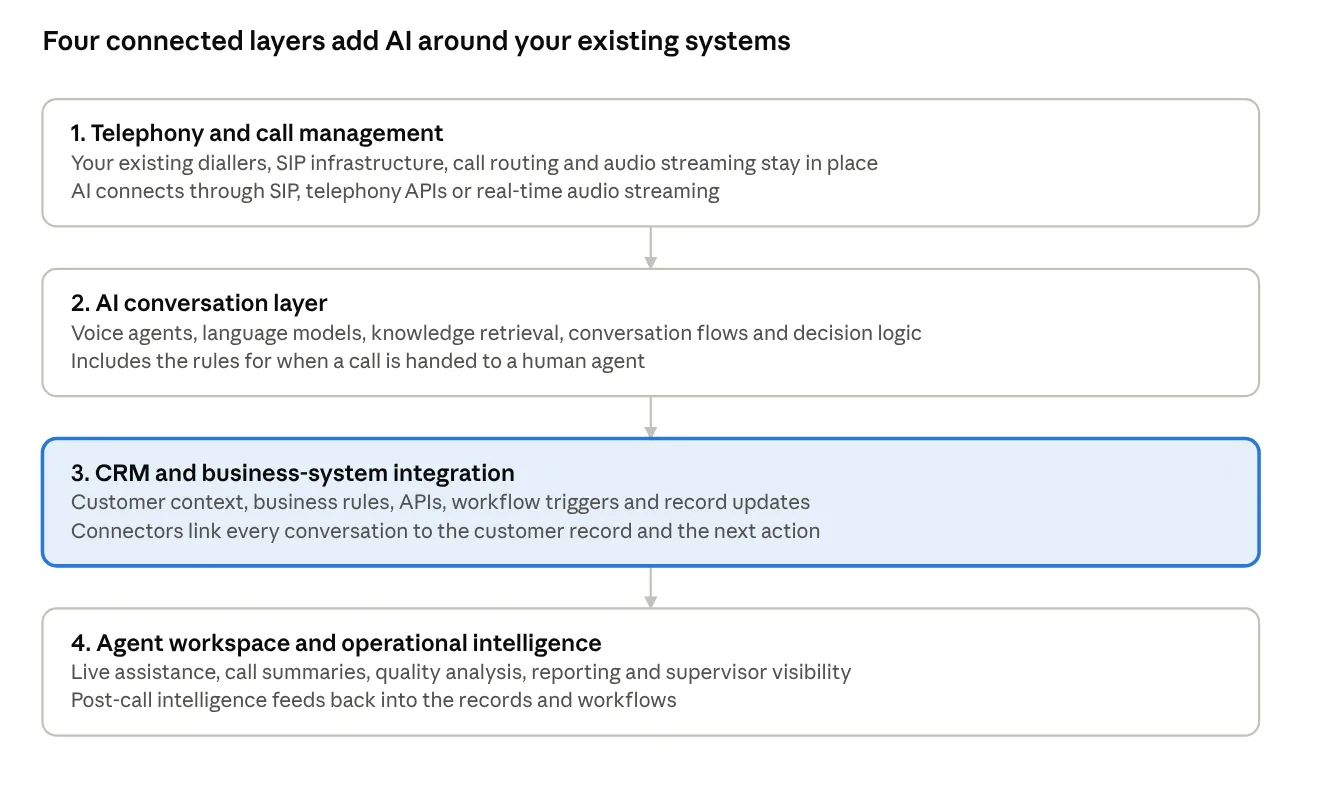
Read it from the top: a call enters through your telephony, the AI layer handles it, the integration layer connects it to your business systems, and the workspace gives your people the context and visibility they need.
The foundation is telephony and call management. This is where your existing diallers, SIP infrastructure, call routing and audio streaming live. Superteams connects AI capabilities to that calling infrastructure through suitable SIP connections, telephony APIs or real-time audio streaming interfaces, so you keep the setup your operations already depend on.
On top of that sits the AI conversation layer. Here we build voice agents that follow your business rules, retrieve the right information from your knowledge base and data, and handle clearly defined tasks. This layer combines speech interfaces, language models, knowledge retrieval, conversation flows and decision logic, including the logic that decides when a human should take over.
The third component is CRM and business-system integration, which is where the system stops being a standalone bot. Using APIs and purpose-built connectors, conversations are linked to customer records, business data and operational workflows. This layer supplies customer context before and during a call, applies your business rules and permissions, and writes outcomes back to your systems.
Finally, there is the agent workspace and operational intelligence layer. Agents get call context and live assistance. Supervisors get reporting and visibility. Post-call intelligence processes every conversation to generate summaries, classify outcomes, identify commitments and support quality monitoring, with consistent conversation histories behind it all.
One thing we are careful about is not overselling. Not every implementation needs a new dialler, a new agent desktop or a complete telephony replacement. In many cases the most sensible approach is to add AI around what works, and replace only what genuinely needs replacing.
An illustrative scenario: adding AI to a dialler you already run
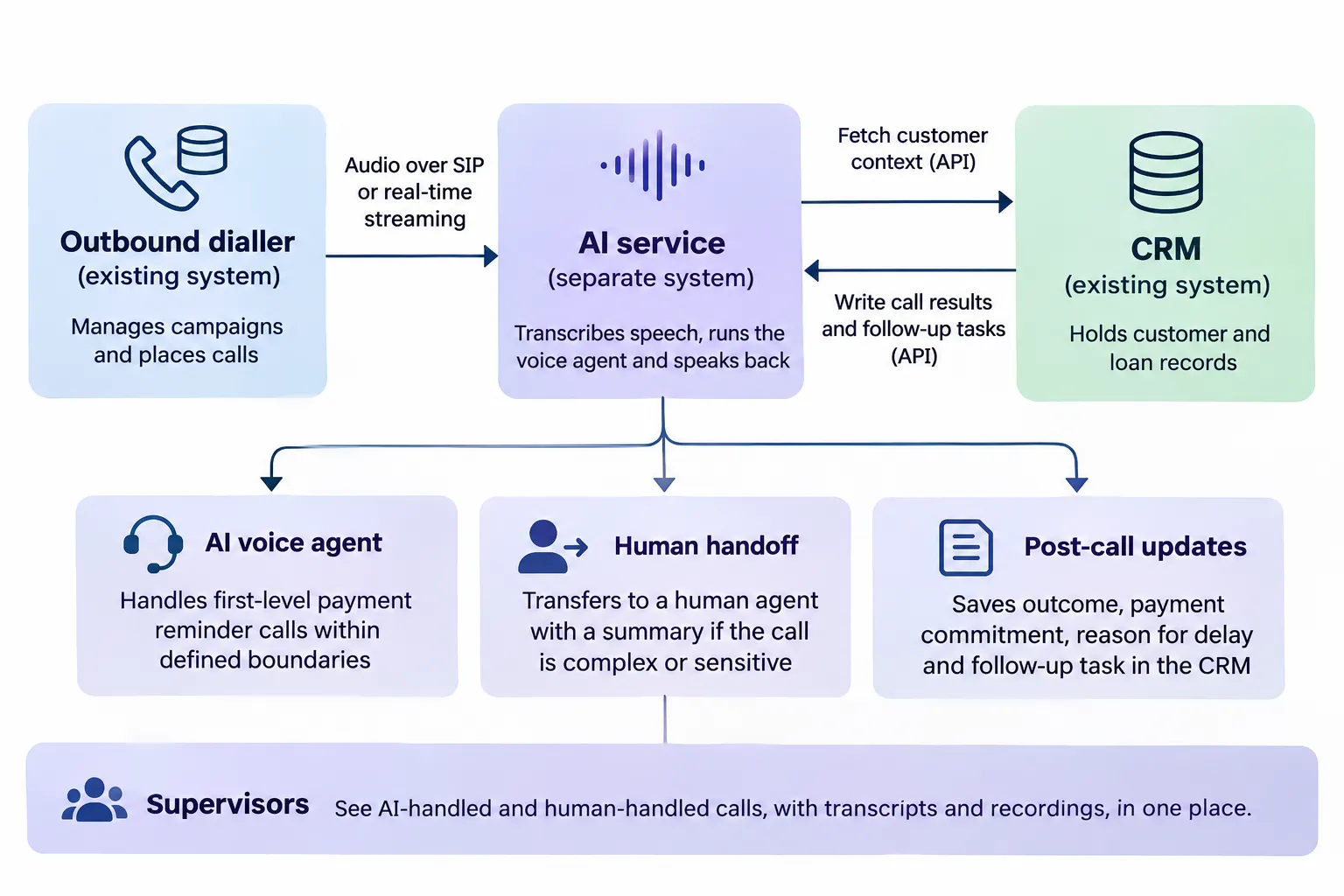
To make this concrete, here is a hypothetical, anonymised scenario. It is a reference pattern, not a description of a specific client project, and the exact build would depend on the dialler and CRM involved.
Imagine a mid-sized lender with an in-house outbound dialler and a CRM that holds its customer and loan records. The team wants an AI voice agent to handle first-level payment reminder calls, without replacing either system.
The dialler keeps doing what it does best, managing campaigns and placing calls. For the calls marked for AI handling, it routes the audio over SIP, or through a real-time audio streaming interface, to a separate AI service. That service runs the voice agent: it transcribes speech, follows the conversation flow you have defined and speaks back with a synthesised voice.
Before the agent says hello, the AI service calls the CRM’s API to fetch the context it is allowed to use, such as the customer’s name, the amount due and the due date. During the call, it only answers within those boundaries, and it hands the call to a human agent, with a summary of the conversation so far, if the customer disputes the amount or sounds distressed.
When the call ends, the service writes structured results back to the same CRM: the call outcome, any payment commitment and its date, the customer’s stated reason for delay, and a follow-up task where one is needed. The transcript and recording are linked to the same customer record. Supervisors then see AI-handled and human-handled calls in one place.
The point of the pattern is the separation. The dialler, the AI service and the CRM stay independent systems, connected through well-defined interfaces, so you can change or upgrade any one of them without rebuilding the others.
From AI-led conversations to human-assisted workflows
It is easier to see how the components fit together by following one call from start to finish.
A customer phones in about a pending payment or a service request. Before the conversation really begins, the AI has already retrieved that customer’s details from the CRM, so it knows who it is talking to and what is outstanding. The voice agent then answers the enquiry or collects whatever information is needed to move the request forward.
If the request turns out to be complex, sensitive or outside the AI’s permitted scope, the call is transferred to a human agent. This is where many systems fall apart, because the customer ends up repeating themselves. Here, the agent receives the conversation so far and the relevant customer context, and picks up exactly where the AI left off.
When the call ends, the system takes over again. It generates a summary, records the outcome and updates the relevant CRM fields. Depending on your configured business rules, it can then trigger follow-up tasks or escalation workflows, such as a callback for the account manager or a flag for the compliance team.
That is the real value. AI is not limited to the opening moments of a call. It takes part in the whole interaction lifecycle, from the first ring to the last CRM update.
Use cases across customer-facing operations
Because the software is built around your workflows rather than a fixed template, the same architecture can be shaped to very different operations. Four areas come up most often.
Customer support and service desks. Voice agents can handle common enquiries, capture service requests, retrieve account information and route complex cases to the right team, with the full context attached.
Sales and lead qualification. The AI can run the first qualification call, collect requirements, schedule follow-ups and update lead records in the CRM, so your sales team spends its time on prospects who are actually ready to talk.
Collections and financial services. For structured collection conversations, the system can capture payment commitments, classify call outcomes and analyse agent and customer interactions. This is a natural fit for banks, NBFCs and lenders that make large volumes of repetitive calls.
Quality assurance and compliance. Calls can be analysed against criteria you define, with potential issues flagged and conversation records organised so supervisors can review them far more easily than by sampling recordings.
Designed around your infrastructure, security and business requirements
If you are an IT leader, your first questions are probably not about what the voice agent can say. They are about what it connects to, where your data goes and what happens when call volumes spike. These are the right questions, and they shape how we scope every engagement.
Start with integration with existing systems. The solution is adapted to your current CRM, telephony providers and business applications, not the other way around.
Deployment flexibility matters just as much. Depending on your infrastructure and data requirements, we evaluate cloud, private cloud or on-premises options. For regulated businesses in India, that choice often depends on where call recordings and customer data are allowed to sit.
Data governance covers access controls, data retention, recording policies and safeguards for sensitive customer information. If you handle personal data, your obligations under India’s Digital Personal Data Protection Act, 2023 should be part of the design conversation from day one.
Then there are model and architecture choices. The right voice models, language models and retrieval components depend on latency, accuracy, cost, language support and deployment constraints. A setup that works for English-first support may not suit a collections team calling in Hindi, Tamil or a mix of languages.
Finally, scalability and reliability. We design for concurrent calls, low-latency audio, graceful handoffs, monitoring and operational resilience.
A note on honesty here. What we implement is specific to each engagement, so we don’t make blanket promises about compliance, security or performance. Those depend on your environment, your requirements and how the system is configured, and we would rather scope them properly with you than assume them.
Why build a custom AI contact centre with Superteams?
A generic platform asks your business to adapt to its way of working. We think it should be the other way around, and four things set our approach apart.
First, it is built around your workflows. AI interactions are configured around your processes, your customer journeys and your escalation rules, not a pre-set script.
Second, it is integrated with your CRM. Call handling, customer context and post-call actions connect to the business systems your teams already use every day.
Third, deployment is flexible. The architecture is designed to fit your infrastructure, privacy and operational requirements, whether that points to cloud, private cloud or on-premises.
And fourth, it is end-to-end. Voice AI, backend engineering, integrations, workflow automation and deployment come together in one implementation engagement, so you are not stitching together five vendors and hoping the seams hold.
The result is a solution that fits your business, rather than one you have to reshape your business to fit.
Move beyond call automation to intelligent customer operations
An AI-powered contact centre is not about swapping human conversations for automated ones. It is about connecting voice interactions with customer data, business logic, human expertise and measurable outcomes, so that every call leaves your business a little smarter than before.
That is where Superteams.ai fits in. We help companies design, build and deploy these capabilities within their existing customer operations, shaped around the CRM, telephony and workflows they already have.
You can modernise how you handle customer conversations without treating your CRM, your telephony infrastructure and your AI capabilities as separate systems. With the right architecture and integrations, the contact centre becomes an intelligent extension of your business. If you are exploring what that could look like for your team, get in touch with us and we can walk you through the process.