Open ten resumes for an “AI engineer” role right now and at least eight of them will say roughly the same thing: worked with LLMs, built agents, familiar with RAG. Almost none of that tells you anything. It’s the AI hiring equivalent of every resume in 2015 claiming to be “detail-oriented.” The words are free, and everyone’s learned to use them.
The actual question you’re trying to answer, whether you’re a CTO who needs an agentic workflow built or a founder who needs your first AI hire, is much narrower: can this specific person do this specific job, at the level your team already operates at. Resumes can’t answer that. A thirty-minute interview usually can’t either. So we built a process that’s designed to answer it properly, and this post walks through exactly what happens, end to end, between “we need an AI engineer” and someone actually starting work.
Finding talent: two funnels, one pipeline
Everything starts with two separate front doors that feed the same pipeline.
On the company side, it starts with a short lead generation form: your name, your title, your company website, and roughly how big your team is. That’s enough for us to route you correctly. If what you need is well defined, you go straight to a set of suggested AI team compositions built around your situation. If it needs a conversation first, you get a Zoom call on the calendar instead. Either way, the commitment is a response within 48 hours of submitting the form.
On the candidate side, it starts with a job description, posted where people actually look for work: LinkedIn, Indeed, and similar boards. Each JD has its own dedicated login on the platform, and someone applies directly against that specific role instead of dropping a generic resume into a black hole and hoping.
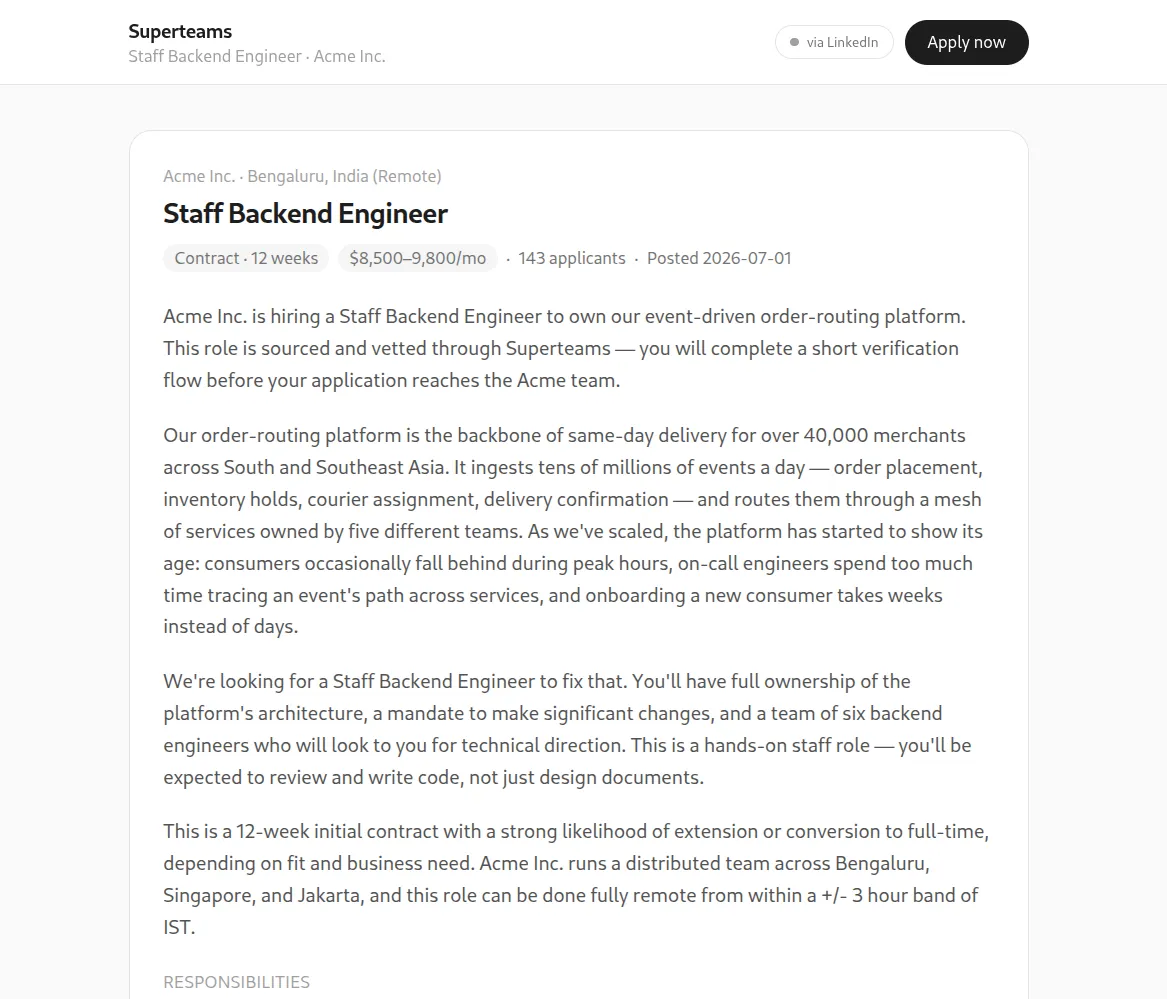
A live role on Superteams: compensation, applicant count, and a note that this posting routes through a short verification flow before it reaches the client’s team.
Discovering talent: a profile, not a PDF
Once a candidate logs in against a specific JD, they first upload a resume. That resume is then screened for a series of tests and interviews.
The more detail you give us upfront, the better the match we can find. We don’t rely on keyword matching alone, we build a fuller picture of your organization so we can find candidates who genuinely fit, not just ones whose resumes contain the right terms. Beyond the specific technical skills you’re hiring for, details about your team’s culture and working style are just as useful to us in narrowing the search.
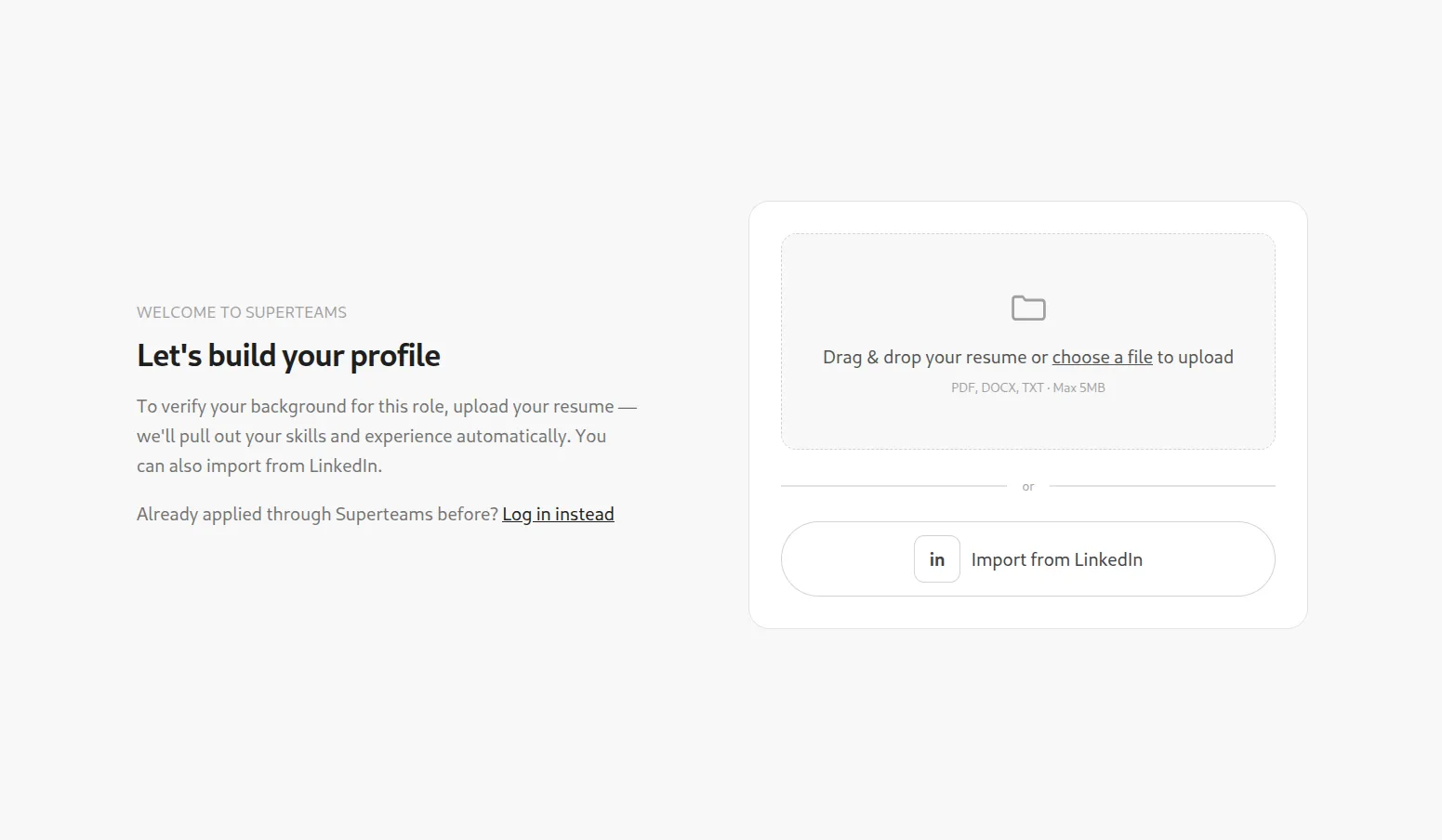
Building a profile: drop in a resume or import straight from LinkedIn.
Vetting talent: the part a resume can’t fake
Every candidate moves through the same four stages.
-
Voice AI screening call. The first pass is an AI voice agent. It calls the candidate and asks a set of foundational questions, the kind that quickly separates someone with real hands-on experience from someone repeating buzzwords off a job posting.
-
Objective assessment. Candidates who clear the screening call move to a graded MCQ assessment to test their technical abilities, concepts and subject matter knowledge.
-
Subjective assessment. A second layer on top of that, which assesses their capacity to think logically, plan, and come up with an architecture. We test them for their ability to complete a full project, using the tools we suggest.
-
Human interview. Only candidates who pass both assessments are cleared for the final set of interviews. We conduct two rounds of interviews with multiple experts in our team to check for leadership qualities, group thinking and work ethics. After that, we set up a call between your team and the candidate.
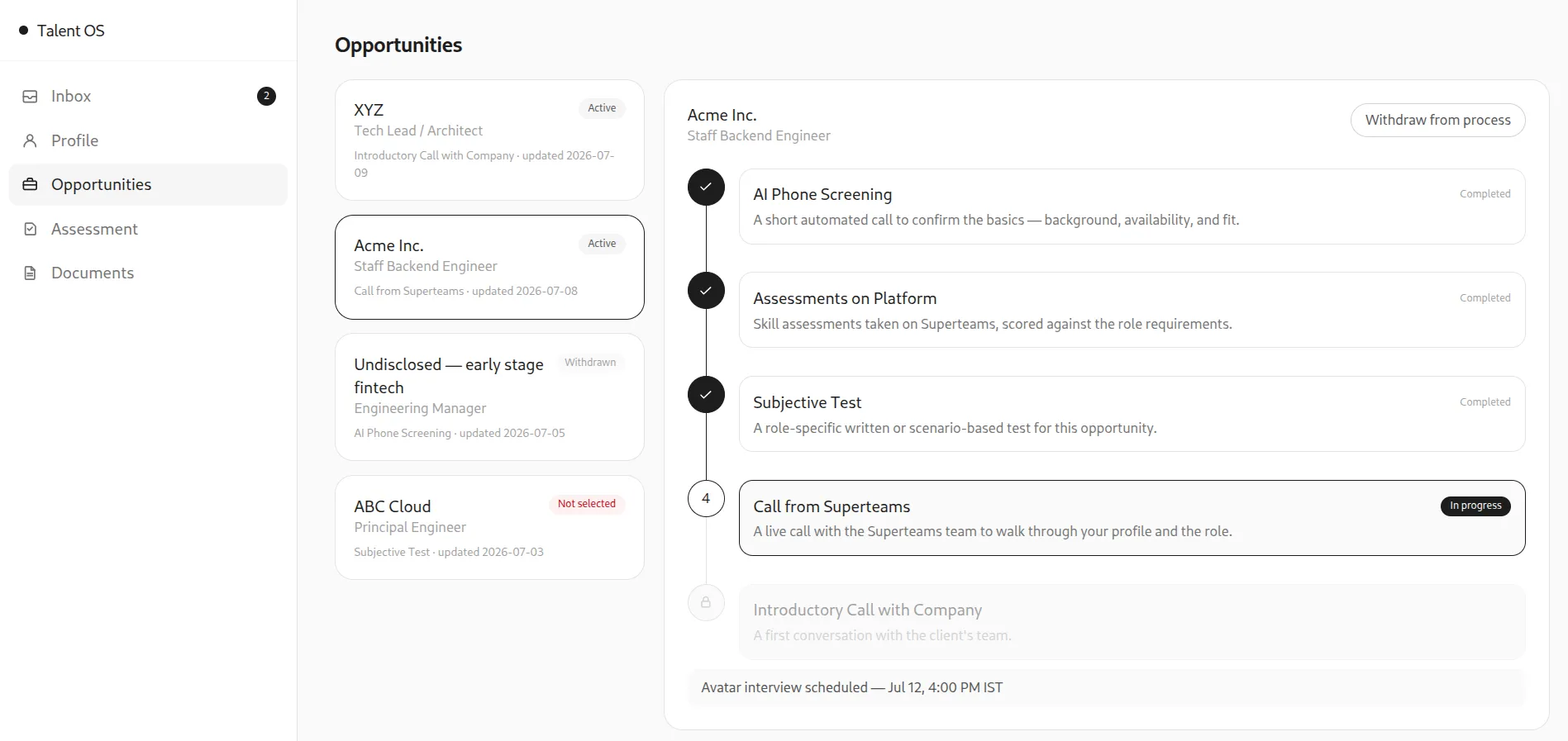
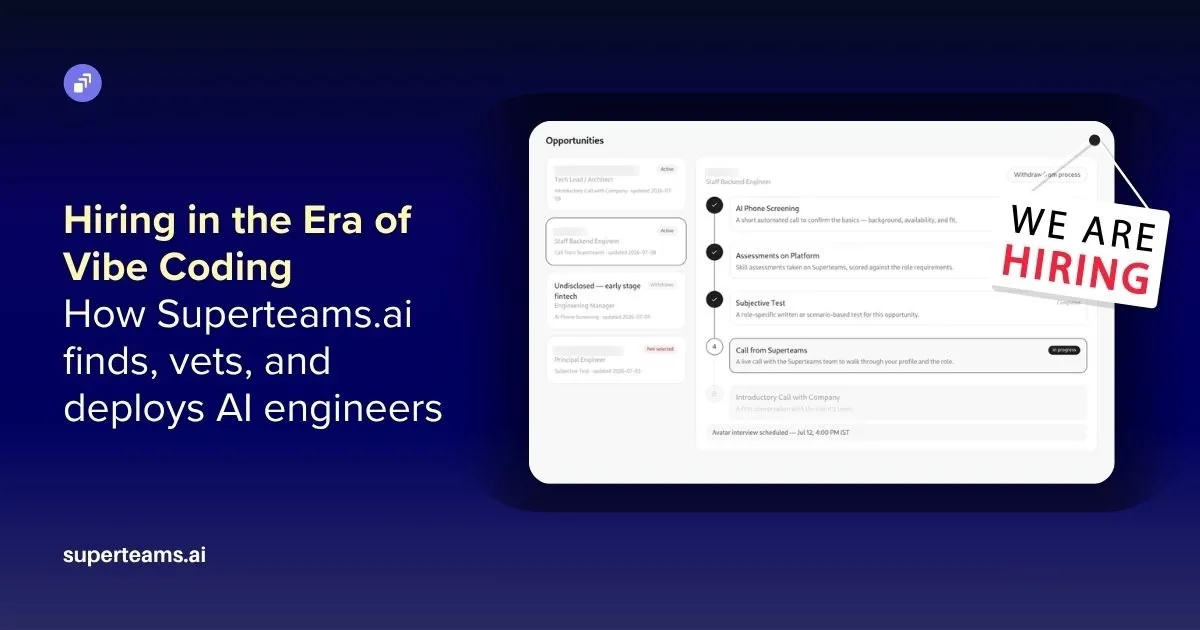
What that pipeline looks like from the candidate’s side: five stages, each one either completed or in progress, so nobody is left guessing where they actually stand.
We have both generic and targeted assessments, meant for specific roles. Alongside a shared library of skill assessments—RAG, voice AI, agent orchestration, prompt engineering—which get tested once and carried across every engagement, companies can share their own tests. Our grading system averages out scores across these different assessments.
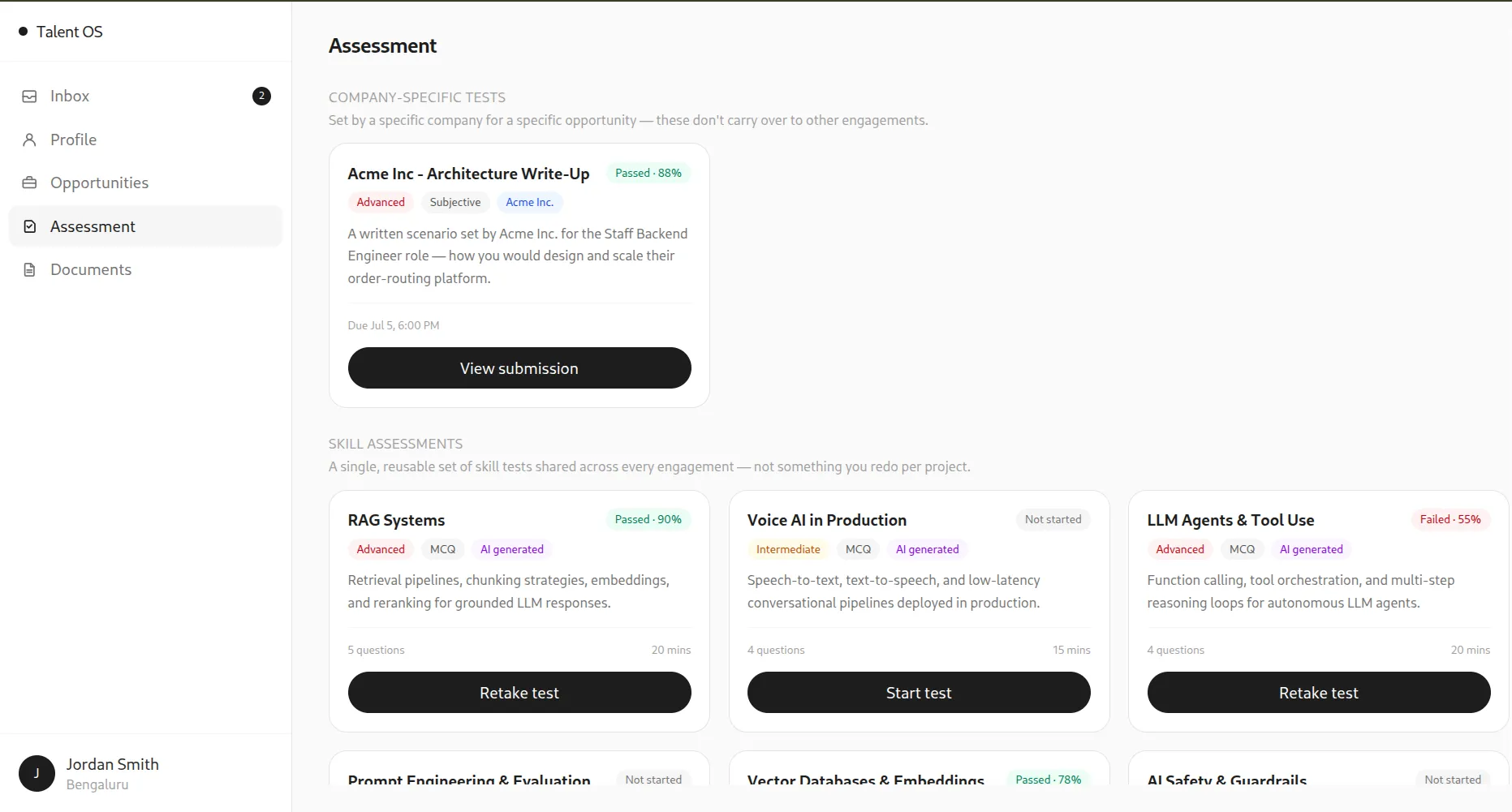
Two tiers of assessment: company-specific take-homes scored against one role, and a reusable skill-assessment library that doesn’t need to be retaken for every new engagement.
We score candidates on these 5 specific metrics.
| What we score | Why it’s on the list |
|---|---|
| Communication skills | Strong verbal and written communication is essential for any embedded employee. We vet candidate speaking and writing abilities to ensure engineers can clearly articulate complex problem statements and technical decisions to non-technical stakeholders. |
| Role & spec fit | Broad buzzwords on resumes often mask actual capabilities. We evaluate a candidate’s precise experience to ensure their hands-on background directly matches the specific technical requirements and context of the role, rather than just the general category. |
| Compensation alignment (CTC) | Misaligned salary expectations are a leading cause of mid-process dropouts and early attrition. Verifying past CTC and expectations upfront guarantees financial compatibility and prevents wasted onboarding time for everyone involved. |
| Verified technical abilities | Hands-on capability must be proven, not assumed. We validate technical skills directly on our platform through practical evaluations, rather than taking resume claims or unverified GitHub links at face value. |
| Ownership & attitude | Remote and embedded contract work requires a high degree of autonomy. We assess a candidate’s mindset to ensure they take full accountability for their deliverables, drive solutions proactively, and operate effectively across time zones without needing constant supervision. |
Deploying talent: vet, groom, hire, deploy
Clearing the tests is where the real preparation begins. Before anyone starts, they go through a grooming stage: a structured briefing on the client’s business, the systems and tools they’ll be working in, the team they’re joining, and what a successful first few weeks actually looks like. This step exists to add context to what each candidate is going to experience.
The nitty-gritties of hiring are handled with the same level of care. Contract terms, compensation, and start dates are settled before deployment begins. The team is first internally deployed by us so we are assured that the engineering talent is able to take on complex problem statements. After the MVP is built, the team starts actively working with the company. We still stay involved for the first couple of weeks to ensure a smooth transition.
This entire process of vetting, grooming, deployment and hiring runs as one continuous, seamless process. It’s also built around a firm commitment to be on time. From the moment your form comes in, you’re either on a call with us or looking at a shortlist within 48 hours, and once you’ve made your choice, deployment typically follows within days rather than the weeks a traditional hiring process usually takes.
Picking the shape of your team
Every company is unique; so is their team. We build around what the work actually requires, whether that’s a pre-assembled specialist pod or individual roles picked one at a time:
| Team | What it’s built for |
|---|---|
| Voice AI Team | Engineers who specialize in multilingual voice AI: speech pipelines, real-time transcription, voice agents. |
| Agentic AI Team | Builders of autonomous agent workflows, the kind that plan, call tools, and complete multi-step tasks without a human in every loop. |
| Finance AI Team | Agentic specialists with finance-domain depth: reconciliation, reporting, underwriting workflows, and the compliance edge cases that come with them. |
| PaaS / MLOps Team | Engineers who keep AI systems running in production: infrastructure, deployment pipelines, monitoring, and scaling. |
| AI-Native Platforms | Builders for products where AI is the core experience, not a bolt-on feature, including mobile apps built AI-first. |
| Assemble Yourself | Don’t need a full pod? Pick individual specialists directly, a fractional CFO, an AI developer, an AI architect, whatever the gap actually is. |
Clearing vetting doesn’t reset to zero the next time an opportunity comes up. Every verified skill sits on a permanent scorecard tied to the candidate’s profile, tagged with exactly how it was earned, through an assessment or through an interview, so the next role they’re considered for starts from that record instead of from scratch.
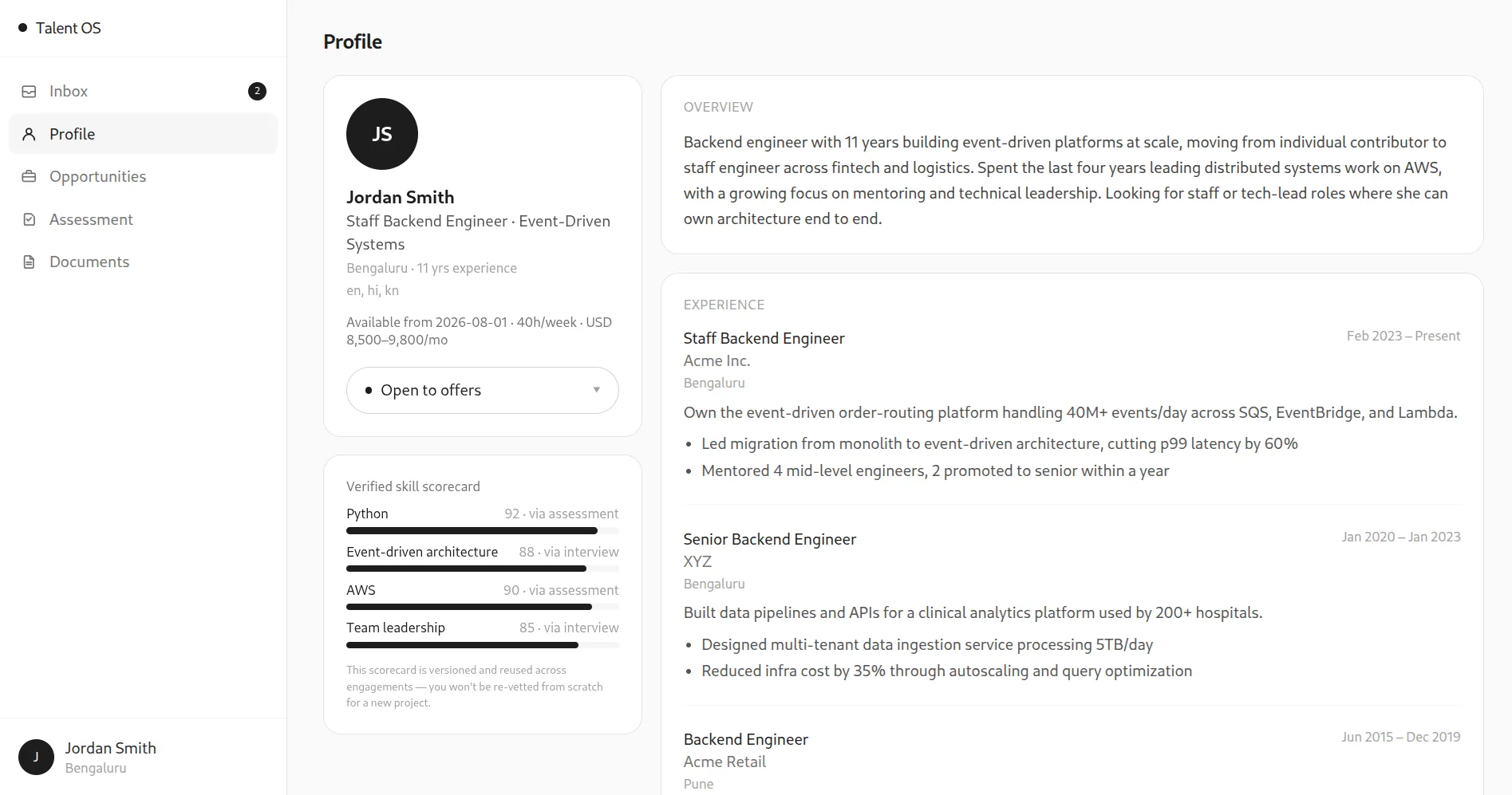
A candidate’s verified skill scorecard: every score is versioned and tagged with how it was earned, then reused across future engagements instead of being re-vetted from scratch.
The final outcome
Once the vetting is done, your dashboard shows a running list of sourced candidates, updated as new people clear the tests, so the pipeline stays live and interactive.
In the era of “vibe coding”—where syntactically sound code can be prompted into existence in seconds—the baseline for evaluating talent has fundamentally shifted. When anyone can generate a working prototype with the right prompt, raw code generation is no longer a differentiator. True engineering value now hinges on system architecture, critical edge-case debugging, clear stakeholder communication, and relentless ownership.
Choosing your team today is about identifying engineers who truly understand what they are building, why it works, and how to drive it forward in a real-world, distributed environment. In a world where AI writes the code, your business ultimately relies on the human who owns the outcome.
If you’re trying to hire AI engineers and tired of guessing which resume is real, this is exactly the process built to fix that.
Book a strategy call with Superteams and we’ll walk you through it against your specific need.