For SMEs across India, Tally is the backbone of accounting operations. It manages ledgers, vouchers, GST records, inventory, receivables, payables, and financial statements, and it has earned that position because it’s reliable, deeply familiar, and embedded in the daily rhythm of how businesses manage their finances.
But recording transactions is only one part of the finance function. Once data enters Tally, you still need to reconcile accounts, track receivables, monitor tax liabilities, prepare management reports, analyse cash flow, and answer questions from business leaders. In many businesses, that means exporting reports, combining spreadsheets, and manually piecing together information from multiple sources.
As your business grows, this effort grows alongside it. Industry estimates suggest finance professionals spend nearly 30% of their time gathering, validating, and reconciling financial data instead of analysing it and supporting business decisions. The challenge isn’t a lack of data: it’s the amount of manual work required to turn that data into useful insights.
Tally is excellent at storing financial data. With the right AI layer on top of it, that same data can start working much better for you.
We are talking about being able to generate a Bank Reconciliation Report in minutes instead of hours, pulling up an Overdue Receivables Aging breakdown the moment a customer goes past due, or handing your MD a live Cash Flow Statement without anyone having to assemble it from scratch. Reports like Profit & Loss summaries, Tax Liability Statements, Withholding Tax Logs, and Corporate Entity Transaction Reports, the kind that used to mean a full day of exports and Excel work, can become available on demand. That’s the shift AI is bringing to finance teams already using Tally: not a replacement, but a significant upgrade to what your existing data can do for you.
The Opportunity Hidden Inside Your Tally Data
We all know how much value is sitting untapped inside our accounting systems.
A typical finance manager’s week is filled with exporting reports from Tally, combining multiple Excel sheets, reconciling bank transactions, tracking outstanding receivables, verifying GST and tax liabilities, preparing management dashboards, and following up on missing vouchers. Each of these tasks is necessary, but very little of it directly creates value for the business. It’s the overhead of extracting usable information from data that’s already there. As transaction volumes grow, this overhead can scale up faster than your team does — and that’s where AI changes the equation.
Traditional Tally Reporting vs AI-Powered Finance Operations
| Task | Traditional Tally Workflow | AI-Powered Workflow |
|---|---|---|
| Bank Reconciliation | Hours of manual matching | Automated matching in minutes |
| Receivables Tracking | Manual aging review | Real-time alerts |
| GST Monitoring | Periodic review | Continuous monitoring |
| Management Reporting | Excel consolidation | Live dashboards |
| Cash Flow Analysis | Multiple exports | Instant visibility |
Where Your Finance Team Deserves Better Tools
Getting answers from your data shouldn’t take hours. Tally holds years of transaction history, but extracting a meaningful answer from it usually involves multiple exports, manual spreadsheet work, and consolidation across several reports. Something as straightforward as “which customers are consistently delaying payments?” can easily turn into an hours-long exercise when you’re piecing it together by hand. With AI, that answer is available instantly.
Receivables tracking should be proactive, not reactive. Cash flow is one of the most pressing concerns for any growing SME, yet most finance teams are still manually reviewing debtor aging reports and identifying high-risk accounts without any automated visibility. With AI continuously monitoring your debtor accounts and surfacing overdue invoices before they become a problem, your team can stay ahead of collection risk rather than always playing catch-up.
Bank reconciliation shouldn’t consume your week. Matching book entries to bank statements is one of the most repetitive tasks in finance and one of the most time-consuming when done manually. Finance teams routinely spend hours on this process only to repeat it the following month. AI can match transactions automatically, flag exceptions, and surface unresolved items in a fraction of the time, freeing your team up for work that actually requires their expertise.
Compliance visibility should be continuous, not stressful. Whether it’s GST, TDS, or statutory reporting, finance teams deserve to know where they stand at any point in the month, and not just when a deadline forces a review. With AI monitoring obligations continuously, compliance becomes something you stay on top of rather than scramble to catch up on before every filing period.
Management reporting should be fast, not a production exercise. Business leaders want answers: whether expenses are rising, which customers drive the most revenue, what the current cash position looks like. Getting to those answers shouldn’t require significant manual assembly. With AI-generated dashboards and reports, decision-makers can have real-time visibility into business performance without waiting for someone to build it for them each time.
Where AI Creates Immediate Value
AI doesn’t replace Tally. What it does is sit on top of your existing accounting data and handle the work your finance team is doing after data entry — moving you from bookkeeping to financial intelligence without disrupting the system you already depend on.
Instead of manually hunting for patterns in exported spreadsheets, AI can analyse transactions automatically, detect unusual spending, flag revenue fluctuations, and surface trends your team might otherwise miss. Receivables monitoring becomes continuous rather than periodic. Bank reconciliation, which once took hours, gets done in minutes. Compliance monitoring shifts from month-end pressure to steady, real-time visibility. And management reporting stops being a manual production exercise, with dashboards showing cash position, profitability trends, expense breakdowns, and revenue performance available without anyone having to build them from scratch each time.
How It Works: The Architecture Under the Hood
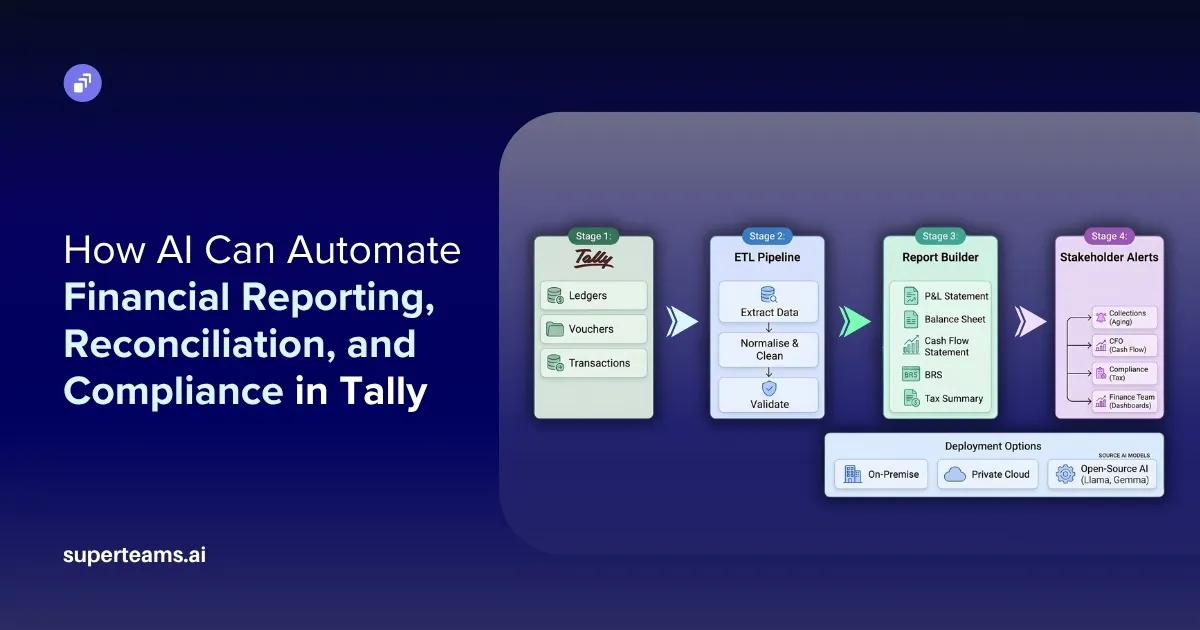
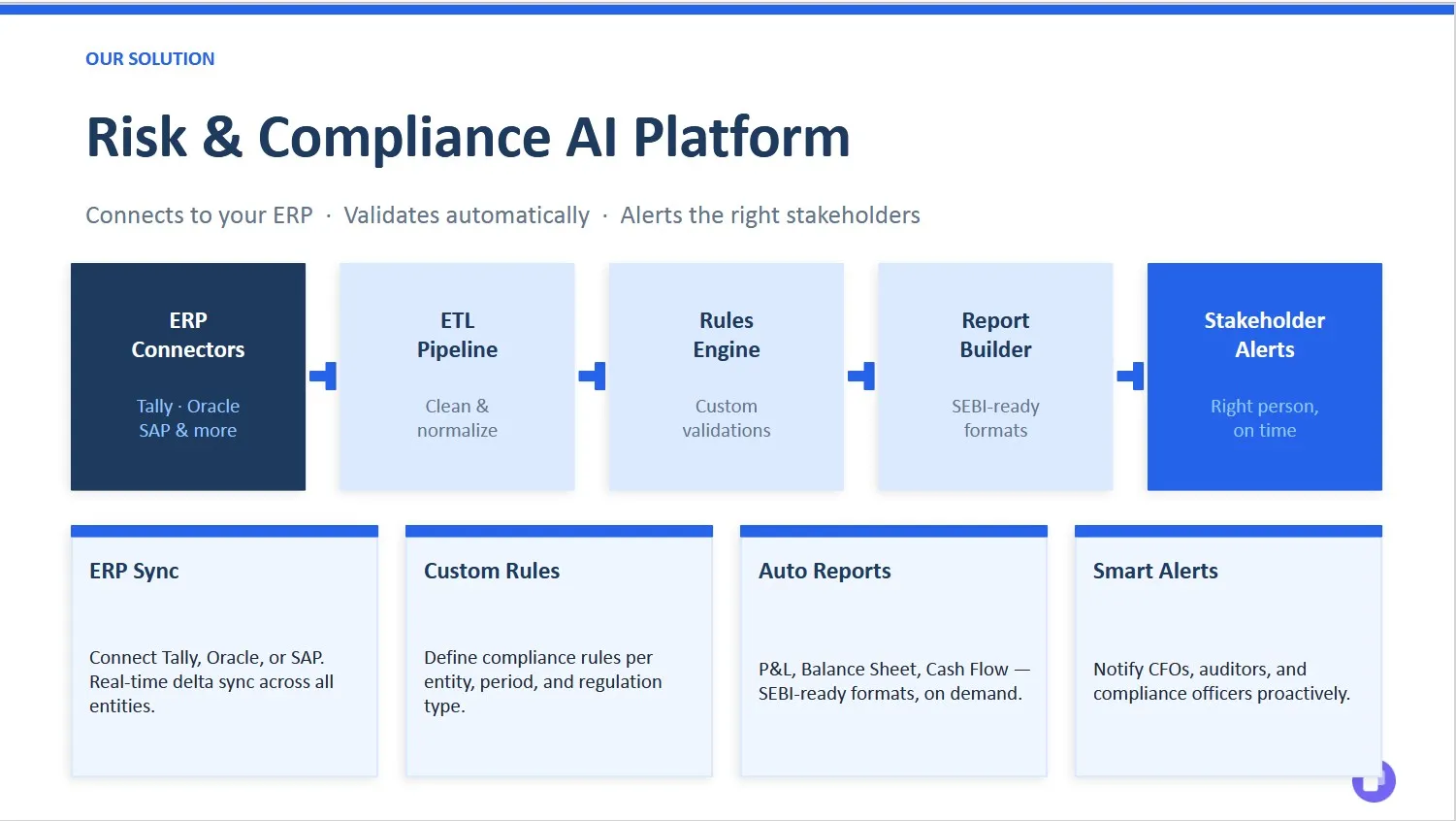
One of the most common questions finance leaders ask is: how does AI actually connect to Tally without disrupting existing workflows? The answer is simpler than most expect. A well-designed AI finance platform operates in four clean stages that sit entirely outside your Tally setup, leaving your core accounting system untouched.
Tally → ETL Pipeline → Report Builder → Stakeholder Alerts & Notifications
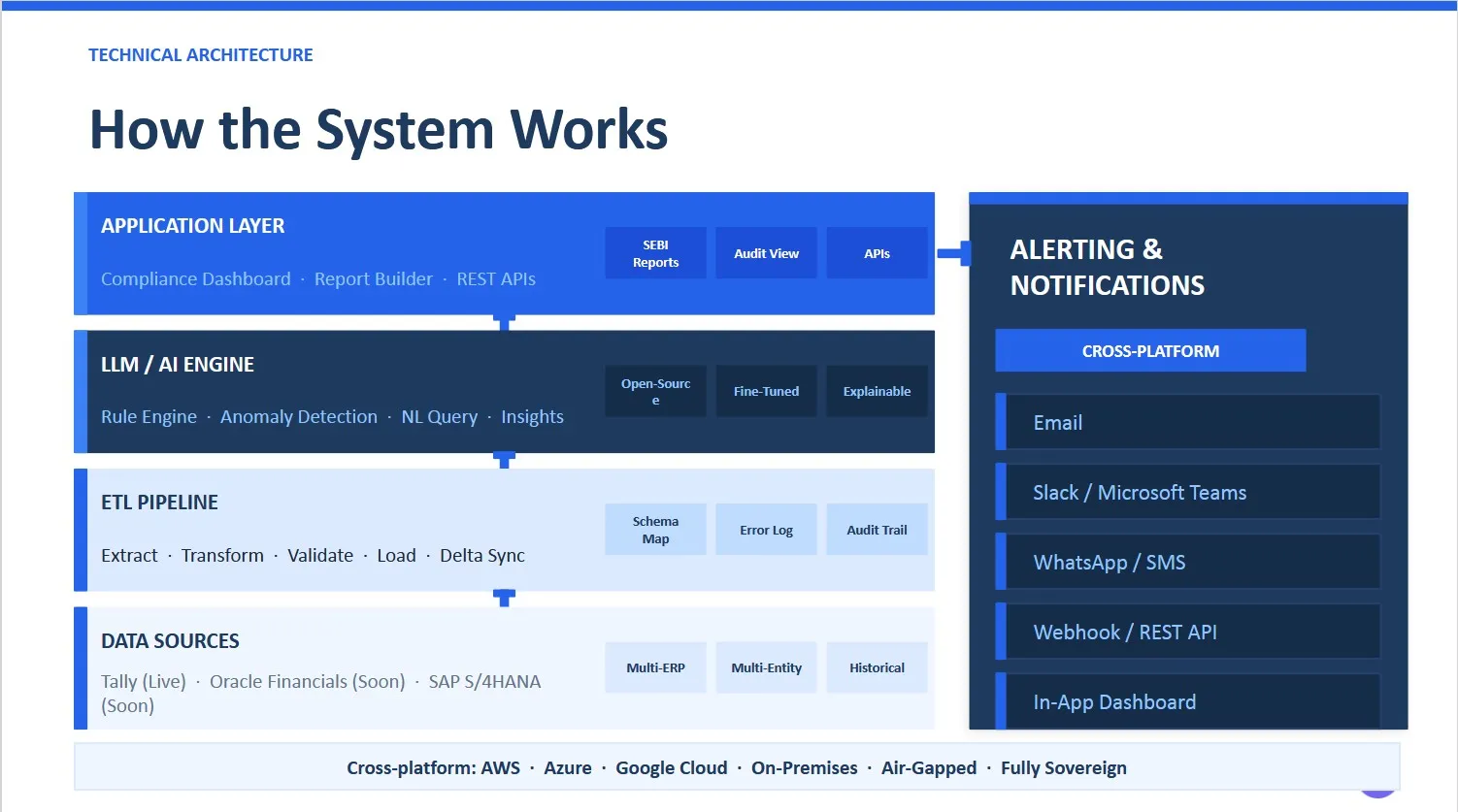
Your Tally data is read through a secure extraction layer: the ETL (Extract, Transform, Load) pipeline, which pulls ledger entries, vouchers, and transaction records from Tally in a structured format. This pipeline normalises and validates the data, handling the kind of inconsistencies that would otherwise cause errors downstream. The cleaned data then flows into a report builder, which assembles the financial reports, dashboards, and reconciliation outputs your team needs, automatically and on a schedule you define. Finally, a stakeholder notification layer pushes the right information to the right people: overdue receivables alerts to the collections team, cash flow summaries to the CFO, tax liability updates to the compliance lead. No one has to log in and pull a report. The system shows what matters to whoever needs it, when they need it.
This architecture means your Tally installation stays exactly as it is. The AI layer reads from it, it never writes back, never interferes with your existing workflows, and adds no complexity to your day-to-day accounting operations.
Your Financial Data Stays Yours: A Note on Data Sovereignty
For finance teams handling sensitive business data, one question matters as much as capability: where does your data actually go? This is a reasonable concern, and it’s one that well-designed AI finance platforms take seriously.
The most flexible implementations today give you genuine choice over how your data is handled. Open-source AI models (such as those in the Llama and Gemma families) can be deployed entirely within your own infrastructure, meaning your financial records never leave your premises. For businesses that prefer cloud deployment, private cloud environments can be configured so that data is processed within a dedicated instance rather than a shared public environment. On-premise deployment is also available for organisations with stricter data governance requirements or regulatory constraints around where financial data can reside.
Beyond data control, this architecture also has a direct impact on cost. When AI models run on your own infrastructure rather than calling external APIs for every query, the per-transaction cost drops significantly. Token costs (the fees associated with sending data to and receiving responses from cloud-based AI models) are eliminated or dramatically reduced when processing happens locally. For a finance team generating hundreds of reports, reconciliations, and compliance checks every month, this adds up to meaningful savings over time. The result is a setup where you get the intelligence of AI without the ongoing API cost overhead, and without compromising on who controls your data.
The Financial Reports Every Business Should Be Generating — Without the Manual Effort
Most businesses are only using a fraction of the reporting potential inside their accounting data. Here are the reports that matter most for financial control and business growth, and what each one actually tells you.
- Profit & Loss Statement
- Balance Sheet
- Cash Flow Statement
- Trial Balance
- Bank Reconciliation Report
- Overdue Receivables Aging Report
- Tax Liability Summary
- Withholding Tax Log
- Corporate Entity Transaction Report
The Next Step for Finance Teams Already on Tally
The good news is that you don’t need to overhaul your accounting setup to unlock these benefits. The data you need is already in Tally. What’s missing is a layer that can read it intelligently, automate the routine work, and surface what matters without manual effort.
NextNeural FinOps AI acts as an intelligence layer on top of Tally, automatically generating financial reports, monitoring compliance obligations, reconciling transactions, and delivering stakeholder-specific insights, all from a single interface, without changing how your team works at the source.
Beyond Off-the-Shelf: Built for Your Business
Every business runs its finances a little differently different report formats, different compliance needs, different stakeholders who need to see different things. While platforms like NextNeural FinOps AI cover the reporting and reconciliation needs most SMEs share, some businesses need something built specifically around how they operate.
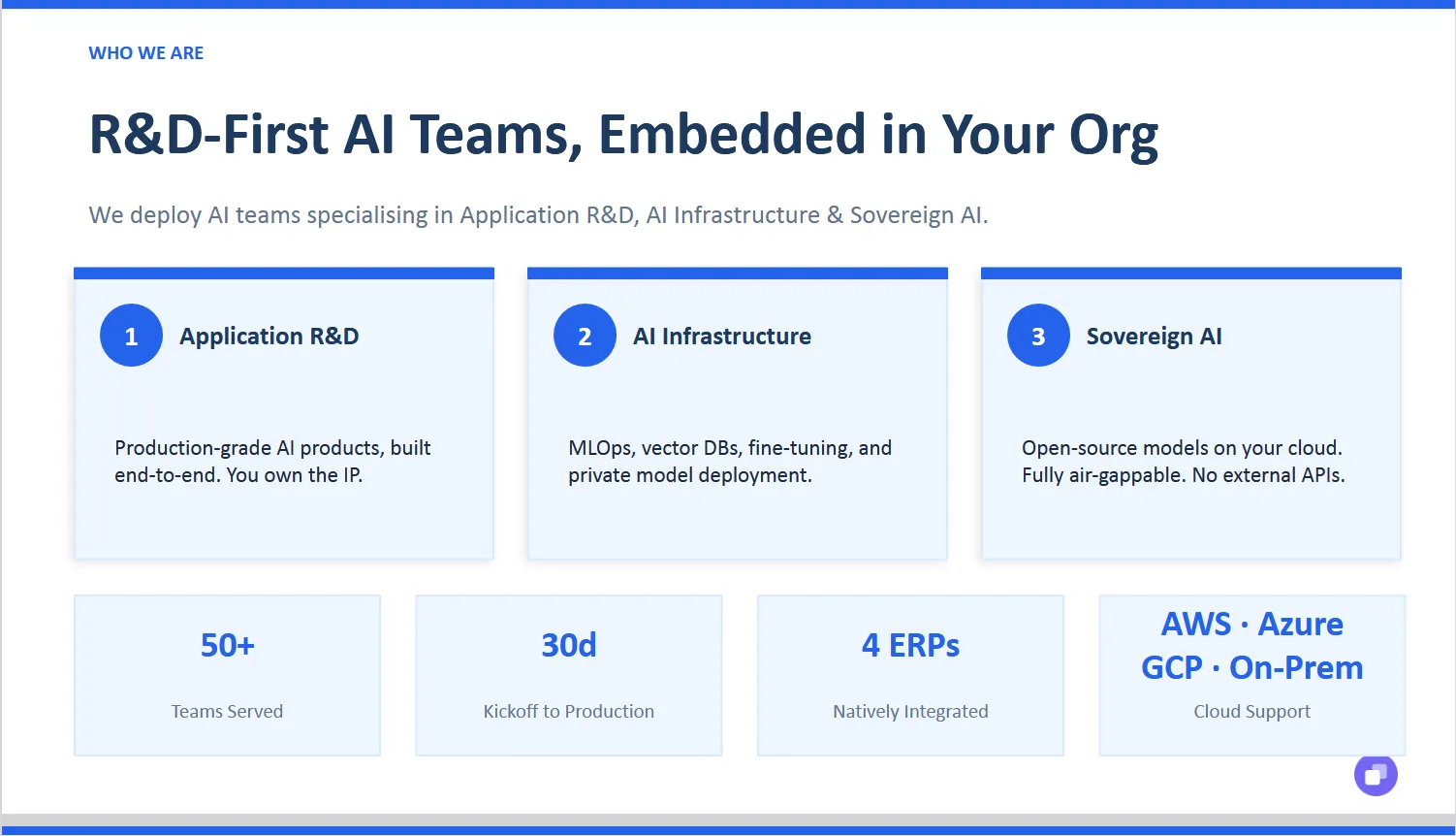
This is where Superteams.ai goes a step further. Beyond ready-to-use finance solutions, Superteams.ai also builds custom AI-powered solutions tailored to a company’s specific data, workflows, and reporting requirements whether that means integrating with multiple accounting systems beyond Tally, designing industry-specific compliance checks, or building reporting formats unique to your business. The goal stays the same either way: turning the financial data you already have into the decisions you need to make, without adding complexity to how your team works. With flexible deployment options ranging from on-premise to private cloud, and open-source model support that keeps token costs in check, we build for finance teams that care as much about data control as they do about capability.