For eleven months of the year, your finance team is focused on the work that actually moves the business forward: managing cash flow, advising on strategy, closing the books on time. Then reporting season arrives, and that same team — often your most experienced, most expensive people — disappears into spreadsheets for weeks. MIS decks. Related party schedules. ESG data calls. GST and tax reconciliations. All pulled together by hand, under deadline pressure, with the auditors waiting on the other end.
Here’s the part that should bother you more than it usually does: the data was never missing. It was sitting in your ERP, your HR system, your utility bills, your bank statements the whole time. The problem isn’t that the information doesn’t exist. It’s that consolidating it for a regulatory filing or a board pack is a fragmented, manual exercise that nobody gets around to until the deadline forces them to.
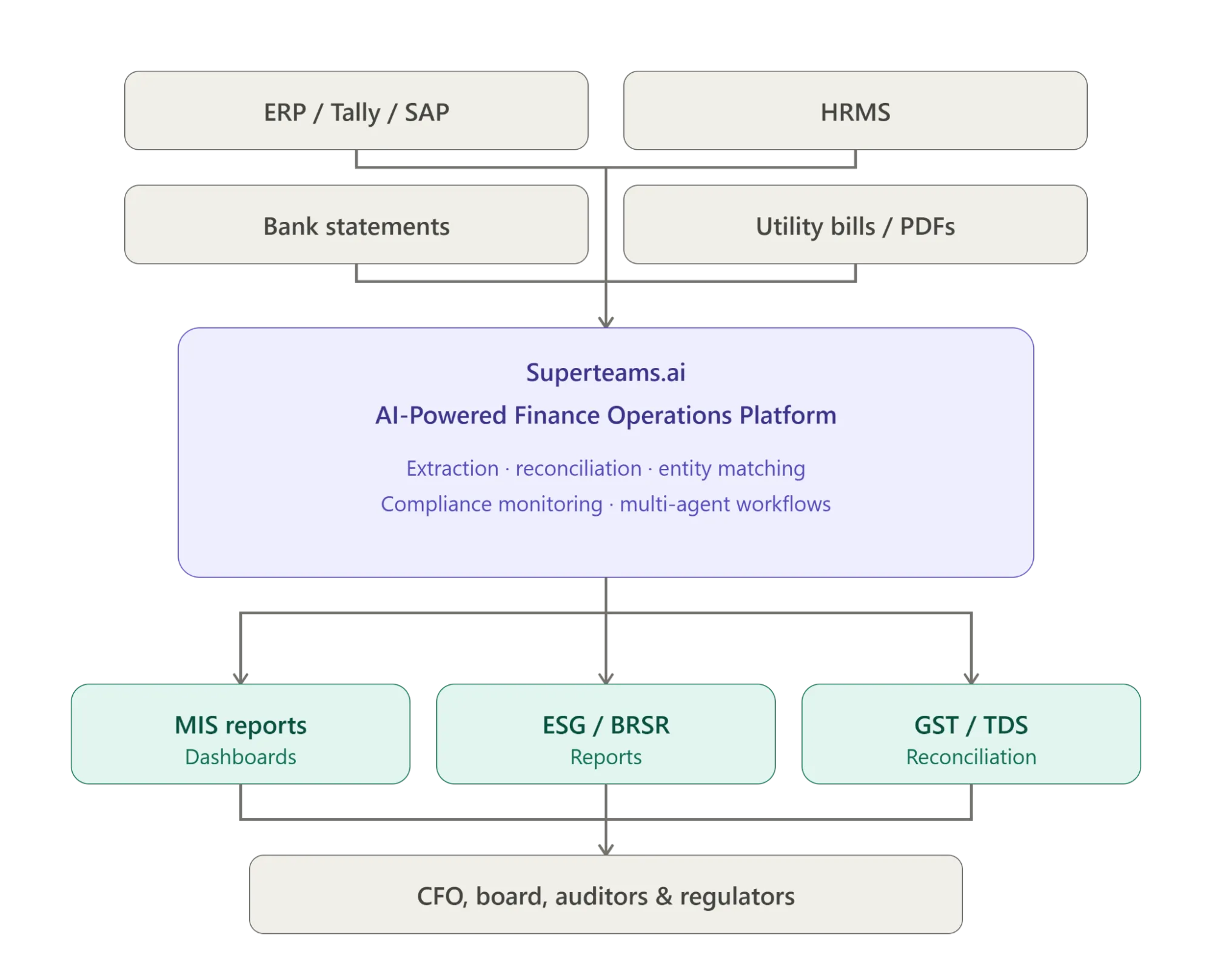
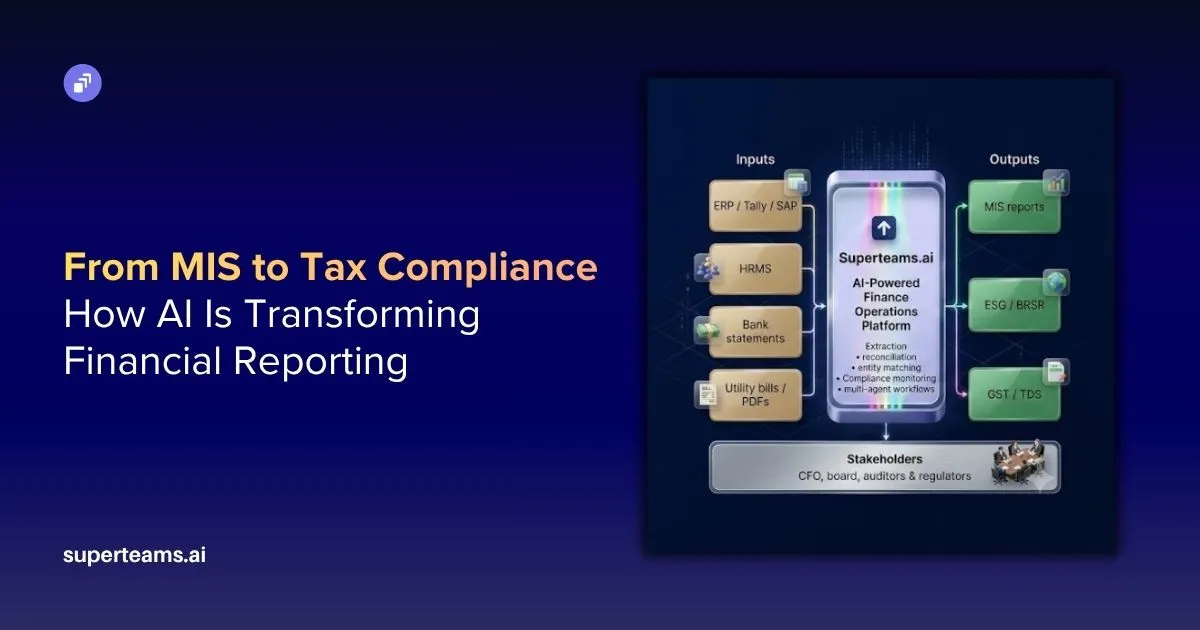
This is where AI for financial reporting and compliance automation are changing the equation. AI doesn’t ask you to replace any of these systems. It sits on top of them as an intelligence layer, continuously extracting and reconciling data so that by the time reporting season comes around, you’re not scrambling, you’re exporting. Here’s what annual compliance reporting automation looks like across four of the reports that consume the most time and risk for Indian finance and compliance teams.
| Reporting Process | Traditional Approach | AI-Powered Approach |
|---|---|---|
| MIS Reporting | Manual monthly compilation | Automated dashboards |
| RPT Reporting | Year-end review | Continuous monitoring |
| ESG / BRSR | Manual document collection | AI-driven extraction |
| GST / TDS Reconciliation | Spreadsheet matching | Automated reconciliation |
MIS Reporting Automation
If there’s one report every finance leader is asked for more often than any other, it’s MIS. Your board, your investors, your management team all want a current, accurate view of how the business is performing, and they want it without waiting a week for finance to assemble it. Yet for most companies, MIS reporting still means someone exporting data from the ERP, rebuilding the same pivot tables every month, and chasing department heads for numbers that should already be sitting in the system.
What changes with AI MIS reporting:
An automated MIS dashboard pulls directly from your ERP, accounting software, and other source systems on a schedule you set, so the numbers are already current before anyone asks for them. Instead of rebuilding the same P&L summary, cash position, expense breakdown, and revenue trend every month by hand, AI agents assemble the financial MIS dashboard automatically and route it to the right stakeholders — your CFO, your board, your business unit heads — without anyone logging in to pull a report.
This is also where automated MIS reports start paying off beyond just speed. Because the underlying data is reconciled continuously rather than once a month, the numbers your leadership team sees are more reliable, and the variance analysis (budget versus actual, this month versus last) happens automatically instead of being a separate manual exercise tacked on at month-end. MIS reporting automation turns what used to be a recurring fire drill into a standing, always-current view of the business.
AI for Related Party Transaction Reporting
Auditors and regulators scrutinise RPTs closely, and for good reason. They want to know that every transaction between your company and a related entity is priced at arm’s length, with no conflict of interest hiding in the numbers. For a company with thousands of transactions running through dozens of subsidiaries, directors, and group entities, doing this check manually at year-end is asking for trouble. It’s slow, and worse, it’s exactly the kind of work where a tired analyst misses the one transaction that draws regulatory attention.
What changes with continuous monitoring?
Instead of a once-a-year sweep, AI agents sit on your ledger continuously, checking every entry against a live database of related entities, directors, and their known associations. The moment a transaction touches a related party, it’s flagged — not before year end in March, but the day it happens.
These agents go a step further than simple matching. They watch for pricing anomalies and margin deviations against comparable arm’s-length transactions, so if something looks off, your team knows about it while the context is still fresh, not months later when someone’s trying to reconstruct why a price was set the way it was. That gives you time to document a justification before an auditor ever has to ask for one — which, frankly, is a much better position to be in.
AI for ESG & BRSR (Business Responsibility and Sustainability Reporting)
If RPT reporting is tedious, BRSR is something else entirely. It’s notoriously unstructured, and the data you need for it rarely lives in finance. You’re pulling energy consumption from utility bills, diversity metrics from HR systems, supply chain compliance clauses from vendor contracts, and emissions data from factory logs that may or may not be digitised. Pulling all of that together usually means weeks of cross-departmental emails and someone in finance manually retyping numbers from a PDF into a spreadsheet.
What changes with AI for ESG reporting?
This is where a multi-agent approach earns its place. Rather than one tool trying to do everything, you can run a small team of specialised agents: one parses utility PDFs to pull energy consumption figures, another reads through vendor contracts to check for the specific compliance clauses BRSR asks about, and a third takes everything those agents produce and maps it directly into the BRSR reporting structure.
The result is an automated ETL pipeline (extract, transform, load) that takes you straight from scattered source documents to a report that’s already in the right format. Work that used to take months of back-and-forth between departments becomes something your team can review and finalise in days, with far less risk of a missed data point.
GST and Tax Reconciliation Automation
Year-end tax filing comes down to one requirement that’s simple to state and brutal to execute manually: your accounting software, your bank statements, and the government tax portals all need to agree with each other. Any mismatch — a missed input tax credit, a TDS entry that doesn’t line up — turns into a penalty, an explanation letter, or both.
What changes with GST reconciliation automation?
AI agents can match millions of rows of transaction data against tax portal records in minutes rather than days, surfacing exactly where the gaps are: input tax credits you haven’t claimed, TDS entries that don’t reconcile, vendor filings that don’t match what’s in your books. This is AI for tax compliance doing the part of the job that used to eat entire weeks of an accountant’s time.
The bigger shift, though, is what this does to your visibility throughout the year. Instead of finding out your tax position in March, you know where you stand at any given point — this month, this quarter — because the reconciliation is running continuously in the background rather than as a once-a-year fire drill. Surprises stop being a feature of tax season.
Why Data Sovereignty Matters in Financial Reporting AI
There’s a question every CFO asks the moment AI enters this conversation, and it’s the right one: where does the data actually go? You can’t paste related party ledgers, tax filings, MIS numbers, or supply chain contracts into a public LLM and hope for the best. For finance and compliance leaders, this isn’t a nice-to-have concern — it’s the dealbreaker, and it’s exactly why AI accounting automation has to be built differently for enterprise finance teams than it is for a generic chatbot use case.
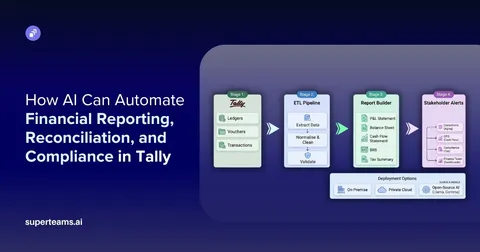
This is where Superteams.ai goes a step further. Beyond ready-to-use finance solutions, Superteams.ai also builds custom AI finance operations solutions shaped around a company’s specific data, workflows, and reporting requirements — whether that means connecting to accounting systems beyond Tally, designing industry-specific compliance checks, or building reporting formats unique to your business. The goal stays the same either way: turning the financial data you already have into the decisions you need to make, without adding complexity to how your team works. Deployment stays flexible, from on-premise to private cloud, with open-source model support that keeps token costs in check. It is built for finance teams that care as much about data control as they do about capability.
What makes this practical at scale is the choice of model deployment. By running fine-tuned open-source models on-premise or in a private cloud, you get the reasoning and extraction capability of large language models without sending a single record to a third-party API. That means no per-query token costs piling up as your reporting volume grows, and, more importantly, absolute control over where your financial data lives. For organisations with strict data governance requirements, that’s not a feature on a slide. It’s the entire basis for being able to use AI on this kind of data in the first place.
Conclusion: Build the Architecture Before the Next Deadline Forces You To
Regulatory reporting isn’t getting lighter, and the demand for faster, cleaner MIS isn’t either. RPT scrutiny is intensifying, ESG disclosure requirements keep expanding, and tax authorities are getting better at catching mismatches faster than ever. Hiring your way through that — adding more analysts every time the reporting load grows — doesn’t scale, and it doesn’t make the work any less reactive.
Financial reporting automation and regulatory reporting automation are the alternative: build the monitoring and reconciliation layer once, run it continuously, and let reporting season become what it should have always been — an export, not an emergency.
If you want to see what this looks like for your specific compliance calendar, book a strategy call with Superteams.ai. We’ll map out an AI-powered finance operations architecture tailored to your reporting, compliance, and reconciliation requirements — deployed on-premise, in a private cloud, or within your existing infrastructure.