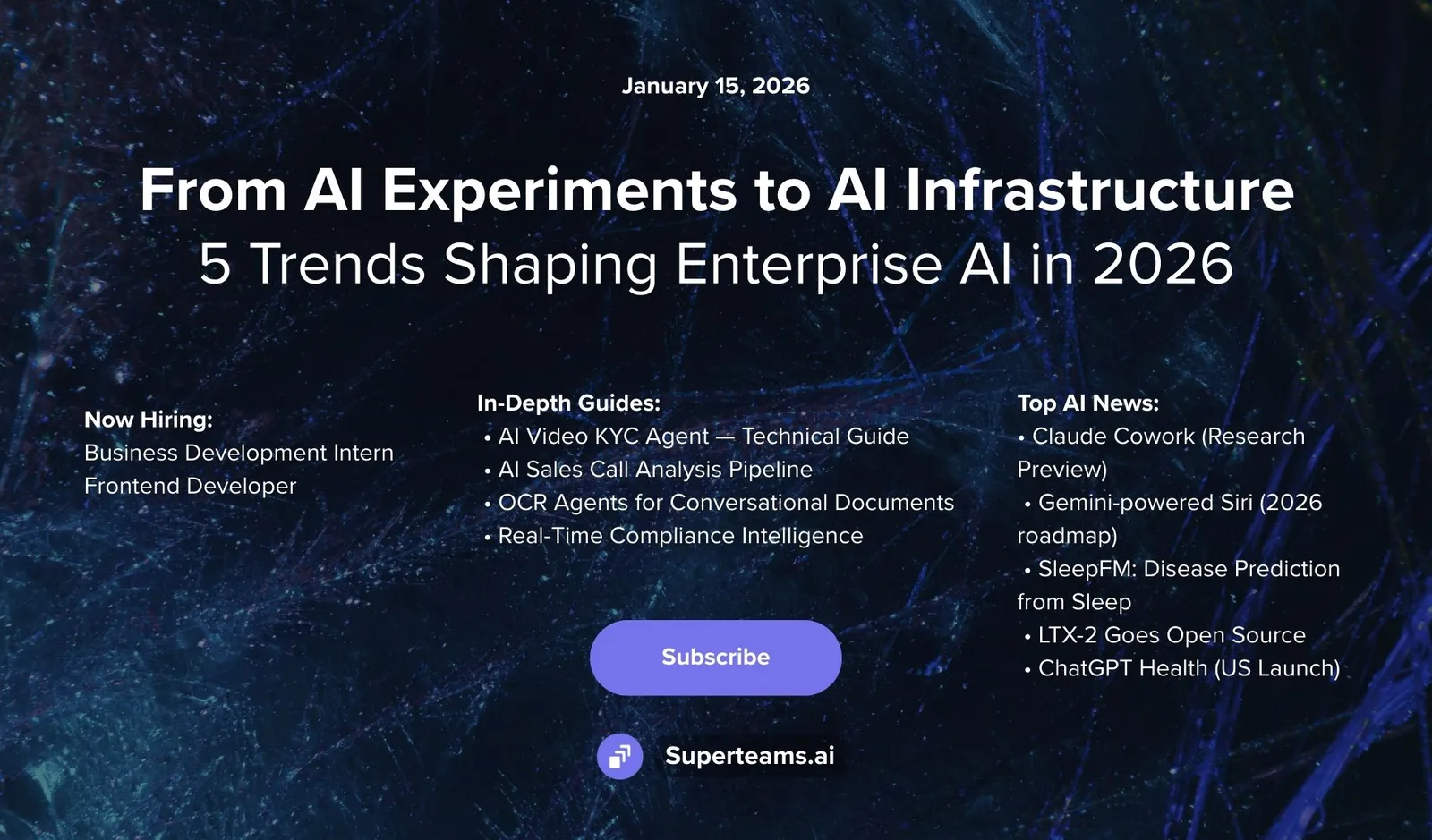
In this New Year edition of our newsletter, we have identified the top 5 AI trends that we believe will be driving AI’s shift from promising experimentation to systems that actively run businesses and organisations.
1. Invisible AI Takes Over the Enterprise Backbone
AI agents have so far been synonymous with just ‘chatbots’. In 2026, they will start working quietly in the background. They’ll monitor systems, enforce rules, reconcile data and fix issues without any explicit prompting.For example, a finance AI agent continuously reconciles invoices, bank transactions, and ERP data. Small mismatches will be fixed automatically; only high-risk anomalies will be flagged for human oversight.
2. World Models Move to the Center of AI Systems
AI will no longer just react, it will think ahead. World models allow AI agents to simulate future outcomes, understand how systems behave, and choose the best action before acting. This will lead to potentially real operational autonomy in 2026.For example, an operation AI Agent can simulate and anticipate supply-chain disruptions days ahead and reroute inventory before any shortages occur.
3. AI-Native Devices Hit Mass Adoption
2026 will be the year AI hardware finally goes mainstream. On-device copilots, edge inference systems, and AI-powered field devices will become standard and not experimental.
4. Emotional Intelligence Becomes a Core Agent Skill
AI agents will get better at understanding how something is said, not just what is said. They’ll detect tone, urgency, frustration, or uncertainty and adapt their responses accordingly. For example, a customer support AI detects frustration in a user’s voice and immediately escalates the issue to a human agent with full context.
5. Agentic AI Connects Systems Across Industries
AI agents will stop being siloed inside one tool or department. Instead, they’ll be orchestrating workflows across multiple systems, domains, and industries handling complex, end-to-end processes. For example, a single AI agent monitors transactions, runs fraud checks, verifies compliance rules, and updates risk scores across banking, payments, and regulatory systems in one unified flow.
In 2026, AI will move from experiment to infrastructure: invisible, predictive, emotionally aware. And agentic systems will become embedded in the core of business operations, determining how enterprises grow across industries.
In-Depth Guides
Getting Started with NextNeural’s AI Video KYC Agent: A Technical Guide
AI Video KYC Agent by NextNeural (a product by Superteams) enables secure, scalable identity verification using multi-speaker detection, lip-sync checks, audio analysis, APIs, and cloud-agnostic deployment.
Building an AI Sales Call Analysis Pipeline with NextNeural
This guide shows how to build an API-driven pipeline on NextNeural to capture sentiment, intent, and missed follow-ups that improve conversion rates.
NextNeural’s AI-Powered OCR Agent for Conversational Document Processing
Transform document workflows with AI-powered OCR agents on NextNeural. Upload PDFs, extract insights, and query reports, invoices, and compliance files through natural-language APIs.
Inside the NextNeural Compliance Agent: Real-Time Intelligence from Policy and Regulatory Texts
NextNeural’s Compliance Assistant streams AI answers from RBI circulars in real time, using SSE APIs to extract guidelines, reduce manual tracking, and simplify regulatory workflows
What’s New in AI
Claude Cowork Research Preview
Anthropic rolled out Cowork, a research preview extending Claude beyond chat to perform real work: read/edit designated folders, organize files, draft reports, and automate tasks. Available now on macOS for Claude Max subscribers, with broader support and safety improvements planned.
Apple to Use Google’s Gemini AI to Power Siri Upgrade
Apple announced a multi-year partnership with Google to integrate Gemini AI models and cloud tech as the foundation for a more advanced, personalized Siri launching later in 2026, strengthening Apple’s AI roadmap while maintaining privacy standards and underscoring Google’s AI leadership.
A Multimodal Sleep Foundation Model for Disease Prediction
Stanford researchers developed SleepFM, a multimodal AI trained on 585,000+ hours of sleep data from ~65,000 people. It predicts future risk for ~130 diseases—including dementia, heart disease, stroke, and mortality—with strong accuracy from one night’s polysomnography, highlighting sleep’s untapped predictive power for health outcomes.
Lightricks has open-sourced its LTX-2 multimodal AI model, releasing full weights, training code, and tools. LTX-2 generates synchronized high-fidelity audio and video (up to 20s, 4K/50fps), enabling local, production-ready workflows and community innovation across creative and research applications.
OpenAI launched ChatGPT Health in the US, a dedicated space within ChatGPT for health and wellness queries that securely integrates your medical records and wellness apps for personalized insights—designed to inform, not replace clinicians, with enhanced privacy protections.
Current Openings at Superteams.ai
Frontend Developer
We are looking for a highly skilled and motivated Frontend Developer to help build modern, responsive, and performance-driven user interfaces for our AI platforms. You will work closely with backend, AI, and product teams to translate complex AI workflows into intuitive user experiences.
Business Development Intern
We’re looking for an MBA-graduate Business Development Intern to support our GTM efforts. You’ll work directly with the founding team to work on lead prospecting, engaging enterprise and mid-market prospects, and supporting data-driven outbound and inbound GTM initiatives.
About Superteams.ai
Superteams.ai organizes trained and vetted fractional AI teams that function as your extended R&D unit. We bring in specialized AI talent to rapidly prototype, deploy bespoke AI solutions, and accelerate your journey from idea to production-ready AI.
Book a Strategy Call or Contact Us to get started.