
Higgsfield is an AI-native creative platform, launched in 2025 and based in San Francisco, that sits on top of the fast-moving field of generative video and image models rather than building a single foundation model of its own. Instead of asking a marketing team or filmmaker to pick one model, learn its prompt quirks, and integrate its API, Higgsfield gives them one workspace and one API key that route to more than 50 video and image models, including Sora, Veo, Kling, and Seedance, alongside a set of proprietary models and cinematography tools it builds in-house. The pitch is less “another video model” and more “the operating layer that makes the current generation of video models usable for production work.”
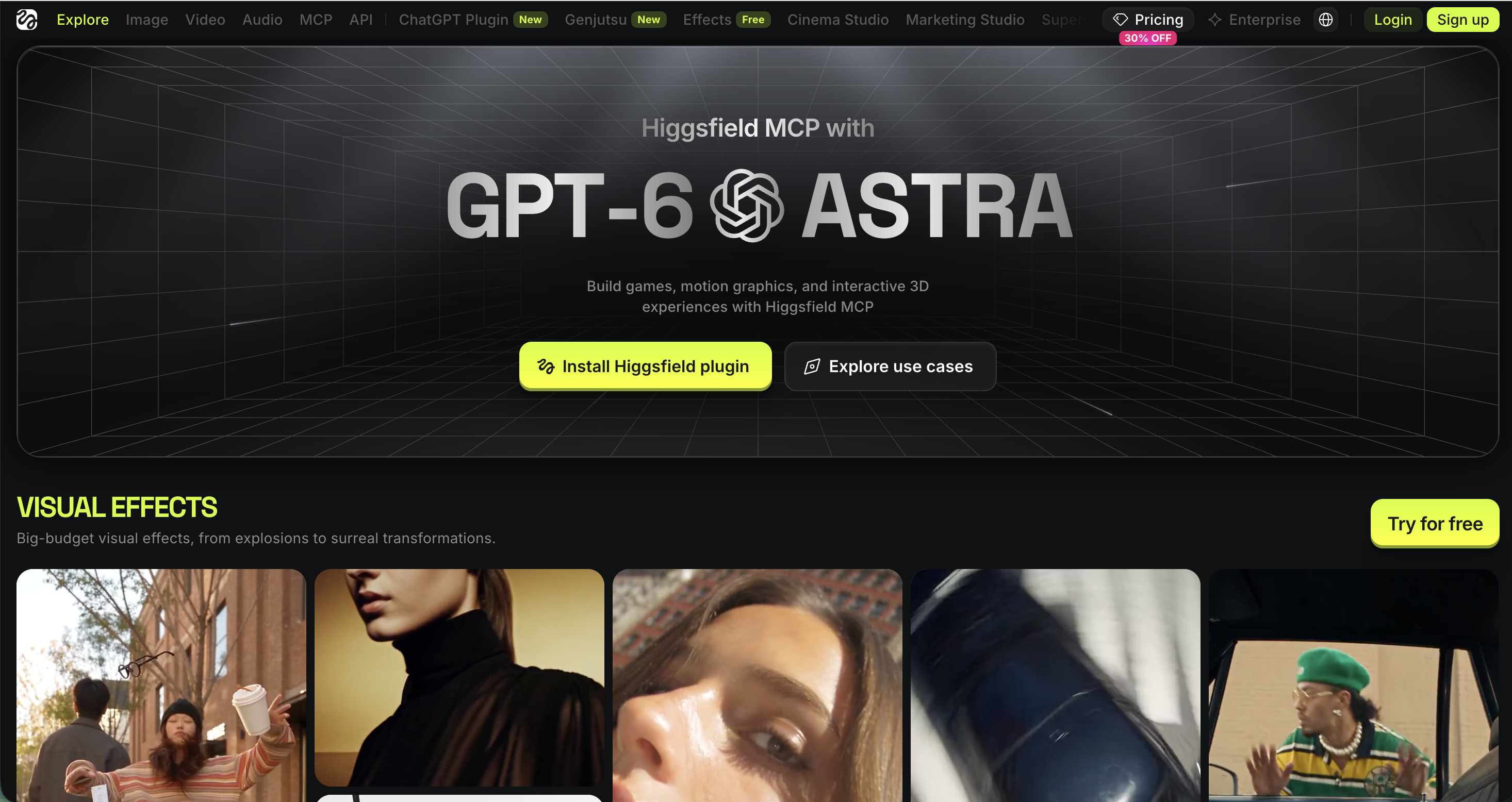
What Higgsfield Actually Does
Most people encounter Higgsfield as a web app: type a prompt, upload a product photo, or paste a reference image, and get back a short, cinematic clip. Under that simple surface, three things are happening that a raw call to any single model’s API doesn’t give you:
- Model routing. Higgsfield decides, or lets the user choose, which of its 50+ partner and proprietary models is best suited to a given shot: Sora 2 for physically accurate world simulation, Veo 3.1 for crisp 4K output, Kling 3.0 for complex multi-shot motion, Seedance 2.0 when the clip needs synced lip movement and audio.
- Consistency across generations. Video models are stochastic by default: ask for the same character twice and you’ll often get two different faces. Higgsfield’s Soul ID system locks a face, body, or product’s visual identity across multiple clips and shots so that a 10-shot ad doesn’t look like it stars 10 different actors.
- Cinematographic control. Rather than accepting whatever camera behavior a model defaults to, Cinema Studio lets a user choose a virtual camera body, lens, and focal length, then lock depth of field, stack camera movements, and apply color grading, closer to directing a real shoot than prompting a model.
Architecture: A Reasoning Engine in Front of Many Models
Higgsfield describes its core differentiator as a proprietary “reasoning engine” and “cinematic logic layer”: a planning stage that runs before any pixel is generated. Given a prompt or a brief, it plans narrative structure, camera logic, and visual consistency requirements, then dispatches the actual generation to whichever underlying model (its own, or a partner’s) is best equipped to execute that plan.
graph TD
    subgraph Input["User Input"]
    A["Prompt, reference image, or product link"]
    end
    subgraph Plan["Higgsfield Reasoning Engine"]
    B["Plan narrative structure & shot sequence"]
    C["Plan camera logic (lens, movement, depth of field)"]
    D["Apply Soul ID for character/product consistency"]
    end
    subgraph Models["Model Layer (50+ models)"]
    E["Partner models: Sora, Veo, Kling, Seedance, Wan..."]
    F["Proprietary: Soul 2, Soul Cinema, DoP"]
    end
    G["Composed, camera-directed video output"]

    A --> B --> C --> D
    D --> E
    D --> F
    E --> G
    F --> G

    classDef default fill:#ffffff,stroke:#4338CA,stroke-width:2px,color:#0F172A,rx:8px,ry:8px;
    classDef data    fill:#EEF0F7,stroke:#0D9488,stroke-width:2px,color:#0F172A,rx:8px,ry:8px;
    classDef process fill:#F7F8FC,stroke:#6366F1,stroke-width:2px,color:#0F172A,rx:8px,ry:8px;
    classDef output  fill:#4338CA,stroke:#4338CA,stroke-width:2px,color:#ffffff,rx:8px,ry:8px;
    class A data;
    class B,C,D process;
    class E,F data;
    class G output;
This orchestration layer is why Higgsfield can absorb a brand-new model, like Sora 2 or Seedance 2.0, within days of its public release: the reasoning engine and consistency tooling (Soul ID, Cinema Studio) stay constant, and only the routing target changes underneath.
Core Products
| Product | What it does |
|---|---|
| Cinema Studio | Virtual cinematography workspace: camera body, lens type, focal length, up to 3 stacked camera movements, depth-of-field lock, and color grading, from a catalog of 1,296 lens combinations |
| Soul ID | Locks a specific face, character, or product’s visual identity so it stays consistent across multiple shots and clips |
| Soul 2 / Soul Cinema | Higgsfield’s in-house photorealistic image models, tuned for fashion, editorial, and cinematic still frames |
| DoP & Keyframes | AI storyboarding and keyframe-driven video generation, letting a director specify start/end frames rather than a single prompt |
| Video-to-Video | Restyle, swap elements in, extend, or upscale an existing clip rather than generating from scratch |
| Enterprise Workspace | SSO, role-based access control, shared credit pools, and dedicated GPU capacity for teams running the platform at scale |
Interactive: Cinema Studio’s Depth-of-Field Control
Cinema Studio’s headline feature is letting a user pick a focal length and aperture and have the platform’s virtual optics render a matching depth of field, the same physics a real cinematographer manages by choosing lenses and f-stops on set. The widget below uses the standard thin-lens depth-of-field formula (hyperfocal distance, near limit, far limit) to show how those two dials actually change what stays sharp in a shot.
The Higgsfield API: Model Access Without Model Lock-In
For teams building their own products on top of Higgsfield rather than using the web app, the Higgsfield API exposes the same model catalog through a single key, generated at console.higgsfield.ai. Billing runs on a prepaid, pay-as-you-go US-dollar balance rather than a subscription: video models are priced per second of output, image models per image, and DoP per generation, with published rates fixed per model. Generation is asynchronous: a request returns a job ID immediately, and the caller polls or listens for a webhook until the output file is ready to download.
# Scenario: an e-commerce backend generating a short product
# video automatically whenever a new SKU is uploaded, without
# hardcoding to one video vendor's API and auth flow.
import requests
import time

API_KEY = "hf_..."
BASE = "https://platform.higgsfield.ai/v1"

def generate_video(prompt, model="seedance-2.0", duration=5):
    resp = requests.post(
        f"{BASE}/video/generate",
        headers={"Authorization": f"Bearer {API_KEY}"},
        json={"model": model, "prompt": prompt, "duration_seconds": duration},
    )
    job_id = resp.json()["id"]

    while True:
        status = requests.get(
            f"{BASE}/video/status/{job_id}",
            headers={"Authorization": f"Bearer {API_KEY}"},
        ).json()
        if status["state"] == "completed":
            return status["output_url"]
        time.sleep(2)

video_url = generate_video("Sneakers rotating on a pedestal, studio light, 35mm lens")
The practical effect of this design is that swapping the underlying model, say, moving from Kling to Seedance 2.0 because a new SKU video needs synced product-demo audio, is a one-field change in a request body rather than a new SDK integration.
Aggregator vs. Calling a Model Directly
| Calling Sora/Veo/Kling directly | Higgsfield | |
|---|---|---|
| Integration | One SDK/API per model, different auth and formats | One API key, one request shape, for 50+ models |
| Character/product consistency | Manual: re-prompt with reference images each time | Built-in via Soul ID |
| Camera control | Whatever the model’s default camera behavior is | Explicit lens, focal length, and movement control via Cinema Studio |
| Pricing | Whatever each vendor charges, billed separately | Single prepaid balance, per-model published rates |
| Model selection | You choose and integrate one model | Reasoning engine can route per-shot, or you pick explicitly |
| Best fit | Teams needing one model’s specific strengths deeply | Teams producing high volumes of varied, on-brand video across changing state-of-the-art models |
The trade-off is the usual one for any aggregation layer: Higgsfield adds a routing and consistency layer that a direct integration doesn’t need to build, at the cost of depending on Higgsfield’s uptime and pricing rather than a single vendor’s.
Business and Scale
Higgsfield is backed by Accel, Menlo Ventures, GFT Ventures, and AI Capital Partners, reaching a valuation above $1.3 billion in an earlier round. In August 2026, it raised a $400 million round led by DST Global at a $5.4 billion post-money valuation, with participation from Tribe Capital, Goldman Sachs Alternatives, Smash Capital, Fifth Wall, Intel Capital, and others. As of January 2026, the company reported an annualized run rate of roughly $200 million, more than 15 million users, and about 4.5 million videos generated per day, with roughly 85% of usage coming from social-media marketers rather than hobbyist creators, a mix the company points to as evidence of repeated, paid, production-workflow usage rather than novelty adoption. By later in 2026, Higgsfield’s own reporting put cumulative usage at over 850 million generations, including 300 million videos, across 25 million users.
What’s New (2025–2026)
Higgsfield launched in 2025, co-founded by Alex Mashrabov, who previously led generative AI at Snap and invented Snap’s camera lenses. Cinema Studio, the platform’s flagship cinematography feature, and Soul ID both shipped as the company moved from a consumer-facing video generator toward an enterprise creative workspace, adding SSO, shared credit pools, and dedicated GPU capacity aimed at brand and agency teams. Through 2026, the model catalog kept pace with the frontier as it shipped: Sora 2, Veo 3.1, Kling 3.0 (including the reasoning-oriented Kling o1 variant), and Seedance 2.0, the first widely available model with synced lip-sync and audio, were all absorbed into the platform within weeks of their public releases, reinforcing Higgsfield’s bet that the durable value sits in the orchestration and consistency layer rather than in owning a single frontier model.
Where It Fits
Higgsfield is best understood as infrastructure for teams that need to produce a high volume of on-brand video across a model landscape that changes every few months, marketing teams, agencies, and platforms building video features, rather than as a replacement for a single model’s raw capabilities. A team that only ever needs one model’s specific strengths, and is comfortable managing that vendor relationship directly, may find a direct integration simpler; a team producing varied output across many campaigns, formats, and underlying models is the case Higgsfield’s reasoning engine and consistency tooling are built for.
How to Use: generating a video through the Higgsfield API instead of a single model's API
# Scenario: a marketing team's backend needs to generate a
# 5-second product video without hardcoding to one vendor's
# (Kling, Veo, Sora...) API, auth scheme, and pricing model.

curl -X POST "https://platform.higgsfield.ai/v1/video/generate" \
  -H "Authorization: Bearer $HIGGSFIELD_API_KEY" \
  -H "Content-Type: application/json" \
  -d '{
    "model": "kling-3.0",
    "prompt": "Product on a rotating pedestal, studio lighting, 35mm lens",
    "duration_seconds": 5,
    "aspect_ratio": "9:16"
  }'
# Returns a generation ID immediately (async job)

# Poll until status is "completed", then download the result
curl "https://platform.higgsfield.ai/v1/video/status/$GENERATION_ID" \
  -H "Authorization: Bearer $HIGGSFIELD_API_KEY"

# Swapping models later (e.g. to Seedance 2.0 for lip-synced
# audio) means changing one field, not integrating a new SDK
Ready to build?
Leverage AI technologies to build your product stack
Superteams can help you build, deploy and launch AI application stacks using open source technologies — from architecture through to production.
Talk to Superteams