We help enterprises unlock compounding growth and operational efficiency through strategic AI consulting and custom platform engineering.









We advise, architect and build custom AI-native platforms for enterprises and high-growth organizations — delivering production-ready systems with 100% client IP ownership across India, the Middle East, Southeast Asia and Europe.
Production systems shipped into regulated, high-stakes environments across global markets.
Full-stack AI products shipped end-to-end — across finance, infrastructure and real estate.
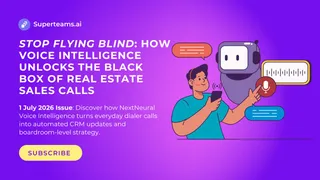
 Every Rep Can Become a Top Performer: Improving Sales Coaching with NextNeural 7 September 2026 Issue: Sellers are 63% more likely to become top performers with regular coaching. Learn how NextNeural turns customer interaction data into account-grounded practice and localized coaching for sales teams. Read more
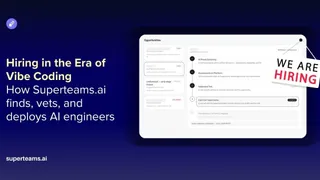
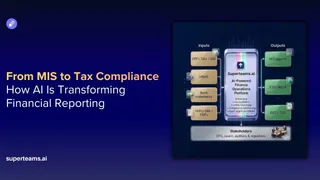
From AI infrastructure companies to SaaS startups, in their own words.
"Superteams actually understands the technology. That's genuinely rare. They come in, read the room, and produce work that holds up to scrutiny from our engineering team."

"The technical depth they bring is what sets them apart. I have worked with agencies before. Superteams is operating at a completely different level."

"Professionalism throughout. They could articulate our product better than most people on our own team. That says a lot."


"Superteams is understanding and quick to pivot in their approach to a solution if they feel that the first approach is not working. Overall, a very supportive company to work with."

Every business is different — we don't believe in one-size-fits-all AI.
Book a free strategy call to explore your use case, discuss technical feasibility, and get practical recommendations tailored to your organization.
Model benchmarks, framework evaluations and applied research from our engineers — fine-tuning, RAG, agents, vision and more.
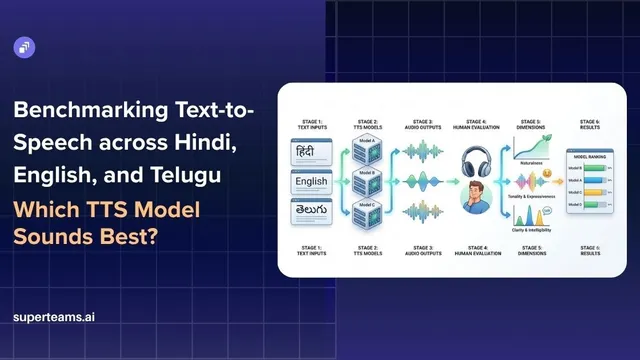 Benchmarking Text-to-Speech Across Hindi, English, and Telugu: Which TTS Model Sounds Best?We ran open-source TTS models through Hindi, English, and Telugu listening evaluations to find out which ones actually sound natural, warm, and clear across all three languages.
Read more
Benchmarking Text-to-Speech Across Hindi, English, and Telugu: Which TTS Model Sounds Best?We ran open-source TTS models through Hindi, English, and Telugu listening evaluations to find out which ones actually sound natural, warm, and clear across all three languages.
Read more
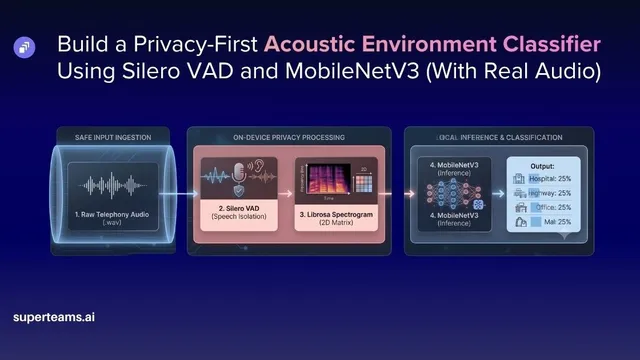 How to Build a Privacy-First Acoustic Environment Classifier Using Silero VAD and MobileNetV3 (With Real Audio)Build a privacy-first pipeline that strips human speech from audio using Silero VAD and classifies the remaining ambient environment with Hugging Face's Audio Spectrogram Transformer.
Read more
How to Build a Privacy-First Acoustic Environment Classifier Using Silero VAD and MobileNetV3 (With Real Audio)Build a privacy-first pipeline that strips human speech from audio using Silero VAD and classifies the remaining ambient environment with Hugging Face's Audio Spectrogram Transformer.
Read more
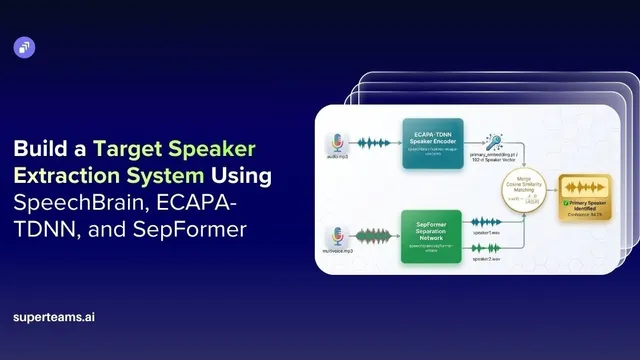 How to Build a Target Speaker Extraction System Using SpeechBrain, ECAPA-TDNN, and SepFormerBuild a Target Speaker Extraction pipeline using SpeechBrain's ECAPA-TDNN and SepFormer models to isolate a specific speaker's voice from mixed audio recordings using cosine similarity matching.
Read more
How to Build a Target Speaker Extraction System Using SpeechBrain, ECAPA-TDNN, and SepFormerBuild a Target Speaker Extraction pipeline using SpeechBrain's ECAPA-TDNN and SepFormer models to isolate a specific speaker's voice from mixed audio recordings using cosine similarity matching.
Read more
The things people usually ask us before booking a call.
We do the thinking and the building. Most firms give you one or the other — a deck full of advice, or a pile of hours against a spec. We bring architecture, product and process consulting, and actual platform delivery in the same team. Our leadership grew up in Big Four consulting, and our architects are founders who have built and scaled real platforms, including India’s largest GPU cloud and its largest cloud telephony platform. So we write the code, harden it, and hand the whole thing over.
It runs in four stages. First we scope and blueprint — we size the compute and pressure-test feasibility before anyone writes code. Then we build the platform around your domain. Then we harden it: deploy it into your private cloud, run the security audit, cut over from legacy systems. Finally we hand everything to your team — the source code, the Terraform and Kubernetes setup, the runbooks, and the training to own it. You come out with a capable internal team, not a dependency on us.
Whatever we build for your platform is yours — the full repo, the infrastructure code, the runbooks, handed over at the end with no license-back and nothing to keep paying us for. If it helps you move faster, you can also build on our ready-made modules for speech, vision and agentic workflows; those stay our IP and we license them to you, while your custom code stays entirely yours. We draw that line clearly at the start so there are no surprises about what you own outright.
On your side of the fence — your private cloud GPU cluster, a sovereign VPC, or fully on-premise. Nothing sensitive leaves for a third-party API, and running your own compute usually cuts ongoing costs by up to 65% compared with paying per call to an external provider.
A new platform built from scratch typically reaches production in three to six months, and it’s yours outright. If you’re modernising instead, we layer private GPU clusters, agentic workflows and low-latency voice onto what you already run without disrupting live operations. We’ve shipped full platforms across web, desktop and mobile in four months.
No — you don’t have to. Our in-house R&D lab, NextNeural, has put 120,000+ hours into speech, vision and agentic components that are already battle-tested. You can start from those and skip months of groundwork, without inheriting someone else’s product baggage.
