
Hermes Agent is an open-source, self-improving AI agent released by Nous Research in February 2026. It is not a coding copilot tied to an IDE or a thin wrapper around a single chat API. It runs as a standalone local process that gets more capable the longer it stays on, learning your projects, writing its own tools, and staying reachable from whichever chat app you already use.
Origin
Nous Research, an organization known for its open-weight Hermes model family, built Hermes Agent as the agent-runtime counterpart to those models. The project’s positioning leans directly on that lineage: “the only agent with a built-in learning loop,” one that creates skills from experience, improves them during use, nudges itself to persist knowledge, and searches its own past conversations. It launched to rapid adoption, reported at roughly 214,000 GitHub stars and 39,700 forks within months.
Architecture
Hermes Agent is built from six cooperating systems:
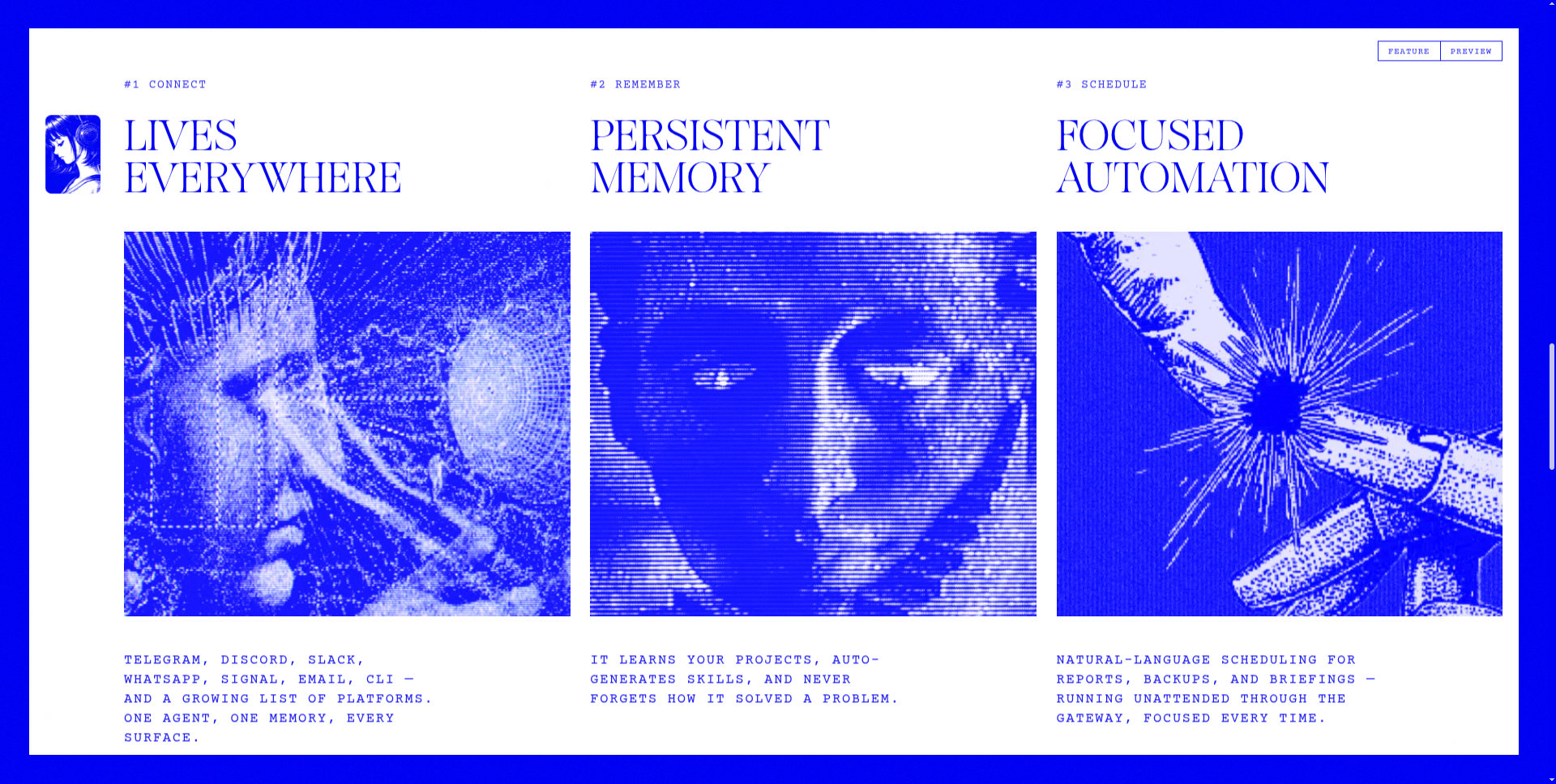
- Gateway: a single process that bridges Telegram, Discord, Slack, WhatsApp, Signal, email, and the CLI, with conversation continuity carried across whichever surface you’re on.
- Memory system: agent-curated persistent memory with periodic self-review nudges, full-text session search (FTS5) with LLM summarization, and Honcho-based user modeling for cross-session recall.
- Skills framework: a procedural-memory layer where the agent writes a reusable skill document after solving a hard problem, so the same fix does not need to be rediscovered next time. Skills are searchable, shareable, and compatible with the open agentskills.io standard.
- Scheduler: a built-in cron system for unattended automation (daily reports, nightly backups, weekly audits) that runs through the Gateway and delivers results to any connected platform in natural language.
- Subagent delegation: isolated parallel workstreams where Python scripts call tools over RPC, collapsing multi-step pipelines into a single turn.
- Terminal backends: six execution environments (local, Docker, SSH, Singularity, Modal, and Daytona), the last two serverless with hibernation between idle sessions to keep cost near zero.
Model Providers & Specifications
Hermes Agent treats the model as swappable infrastructure, switched at any time with hermes model and no code changes:
| Provider | What it offers | Notes |
|---|---|---|
| Nous Portal | 300+ models behind one API key | Includes the Hermes 4 family (up to 405B parameters) plus third-party models |
| OpenRouter | Aggregated access to most frontier and open models | Same routing model as other agent frameworks |
| OpenAI | Direct API access | Standard OPENAI_API_KEY auth |
| Custom endpoints | Self-hosted or OpenAI-compatible servers | Defined in config with a name, base URL, and per-model context_length |
Hermes 4, the flagship open-weight model from the same lab, is built on Meta-Llama-3.1-405B and adds a hybrid reasoning mode: it can deliberate internally with <think>...</think> traces or answer directly, trading latency for depth on a per-request basis. Hermes 4.3 extended post-training to roughly 60 billion tokens of reasoning traces (up from about 1.2 billion for Hermes 4) and was trained on Psyche, Nous Research’s decentralized training network rather than a single centralized cluster.
Model configuration lives in ~/.hermes/config.yaml:
model:
  provider: nous-portal
  model: hermes-4-405b
  default: true

auxiliary:
  vision:
    provider: google
    model: gemini-flash
    api_key: ${GEMINI_API_KEY}
    timeout: 60
CLI & Chat Commands
Every capability is reachable from the terminal, and most slash commands work identically inside a connected chat platform:
| Command | Purpose |
|---|---|
hermes | Start the interactive CLI |
hermes setup | Run the full configuration wizard |
hermes model | Choose an LLM provider and model |
hermes tools | Enable or disable available tools |
hermes gateway | Start the messaging bridge |
hermes doctor | Diagnose configuration issues |
hermes update | Update to the latest version |
/new, /reset | Start a fresh conversation |
/model [provider:model] | Change the active model mid-session |
/skills | Browse skills the agent has learned |
/compress, /usage | Manage and inspect context usage |
Why It Matters
Most agent frameworks treat memory as an afterthought: a vector store bolted on to hold facts. Hermes Agent inverts that, making the ability to learn and remember the headline feature rather than a plugin. Combined with a model-agnostic core and an open skill standard, it points toward agents that keep compounding in usefulness the longer they run, instead of resetting to zero at the start of every conversation.
Hermes Agent vs. OpenClaw
The two projects sit close together in the same local-first, chat-native agent category, and Hermes Agent ships a one-command migration path (hermes claw migrate) that imports an existing OpenClaw setup’s memories, skills, and API keys:
| OpenClaw | Hermes Agent | |
|---|---|---|
| Built by | Peter Steinberger (now stewarded by a foundation) | Nous Research |
| Headline feature | Local-first Gateway across 25+ chat platforms | Self-improving memory and skills loop |
| Skill format | SKILL.md, on-demand loading | agentskills.io standard, self-written from experience |
| Scheduling | Heartbeat (proactive, time-triggered) | Built-in cron scheduler |
| Sandboxing | Docker, SSH, OpenShell | Local, Docker, SSH, Singularity, Modal, Daytona |
| Flagship model tie-in | Model-agnostic from the start | Model-agnostic, with first-party Hermes 4 access via Nous Portal |
Install Hermes Agent and start it up
# Linux / macOS / WSL2 / Termux, no prerequisites needed
curl -fsSL https://hermes-agent.nousresearch.com/install.sh | bash

# Windows (native PowerShell)
iex (irm https://hermes-agent.nousresearch.com/install.ps1)

# Reload your shell, then launch the interactive CLI
source ~/.bashrc
hermes

# Pick a provider and model
hermes model

# Start the messaging gateway (Telegram, Discord, Slack, WhatsApp, Signal)
hermes gateway

# Already on OpenClaw? Import memories, skills, and settings in one step
hermes claw migrate
Ready to build?
Leverage AI technologies to build your product stack
Superteams can help you build, deploy and launch AI application stacks using open source technologies — from architecture through to production.
Talk to Superteams